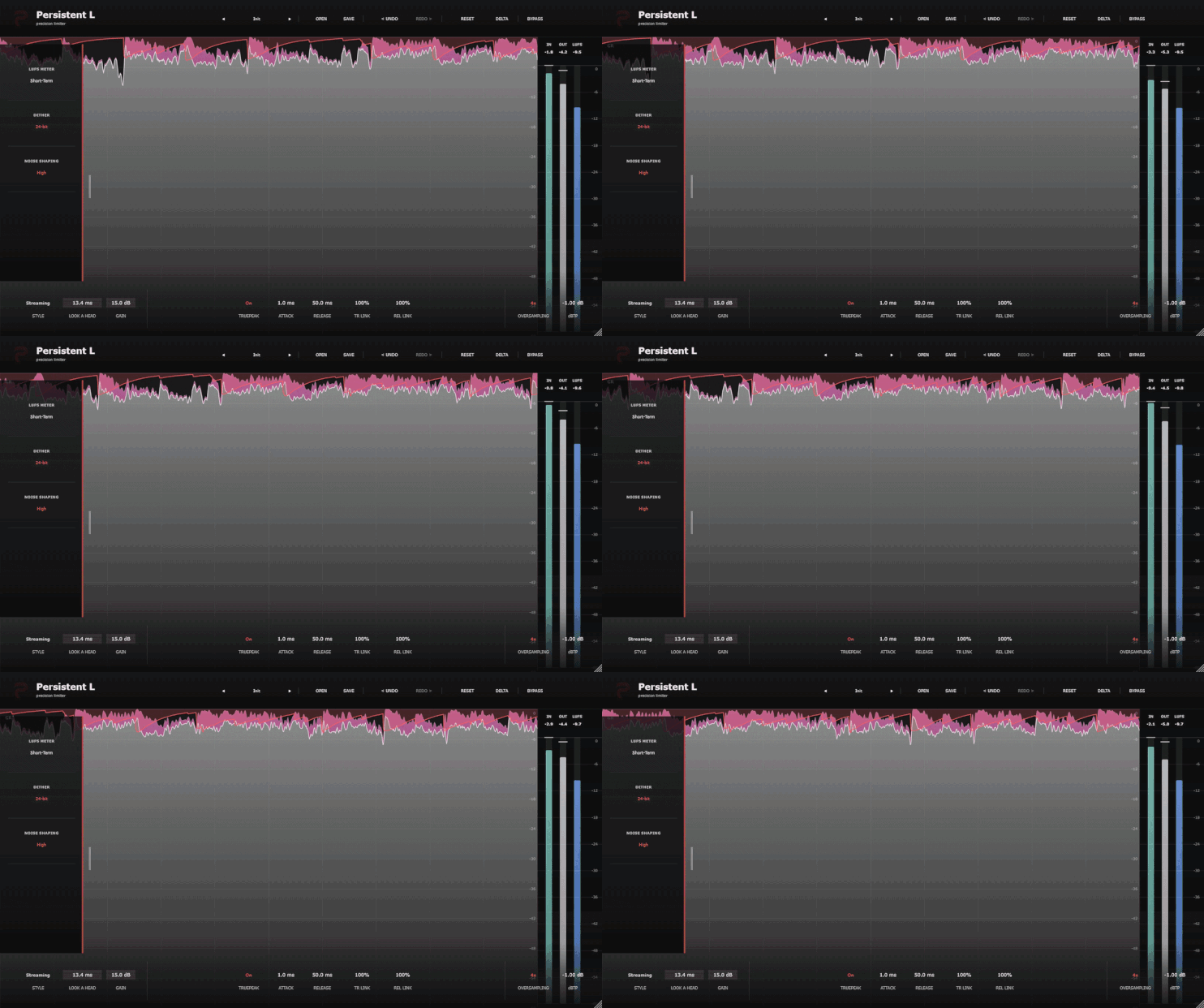
Persistent L : True Peak & Loudness Control
The modern limiter exists at the intersection of two fundamentally different objectives.
The first is peak control.
The second is loudness control.
Although these concepts are closely related, they are not identical. Understanding the distinction between them is essential for understanding modern mastering, streaming delivery, and the role of a precision limiter.
Peak level describes the highest instantaneous amplitude reached by an audio signal.
At any given moment, a waveform may rise to a maximum value before returning to lower levels. Traditional peak metering systems are designed to detect these events and provide a measurement of the signal's highest sample values.
For many years, peak level served as the primary reference for output management.
If the signal remained below digital full scale, the production was generally considered safe for delivery.
In practice, however, listeners do not perceive music through peak level alone.
Human hearing responds to energy accumulated over time.
A short transient may reach a very high peak level while contributing relatively little to perceived loudness. Conversely, a sustained signal with moderate peaks may sound significantly louder because its energy remains present for a longer duration.
This distinction explains why two tracks displaying identical peak values can produce dramatically different listening experiences.
The waveform with greater average energy will generally be perceived as louder, regardless of whether both signals share the same peak level.
As mastering practices evolved, engineers increasingly focused on this relationship.
The objective was no longer simply preventing clipping.
The objective became maximizing perceived loudness while maintaining acceptable sound quality.
Limiting emerged as one of the primary tools for achieving this goal.
By reducing transient peaks, additional headroom becomes available. That headroom can then be used to raise the average signal level, increasing perceived loudness without exceeding the available output ceiling.
At moderate levels, this process can be highly effective.
Transient peaks that contribute little to overall loudness can be controlled while preserving the musical impact of the material.
The challenge emerges as loudness targets become increasingly aggressive.
Every additional decibel of loudness requires further reduction of peak-to-average ratio.
Eventually, the limiter begins to interact not only with isolated peaks, but with the fundamental dynamic structure of the music itself.
Transient detail may soften.
Microdynamics may become compressed.
Spatial depth can diminish.
The mix may begin to feel denser, but also less open and less dynamic.
The art of mastering therefore involves balancing these competing objectives.
Loudness must increase.
Musicality must remain intact.
This balance becomes even more important in modern streaming environments.
Historically, louder masters often appeared more impressive during direct comparisons. Because listeners naturally perceive louder signals as more energetic and exciting, competitive loudness became a significant factor in commercial production.
Streaming platforms have altered this landscape.
Most major platforms now employ loudness normalization systems that attempt to maintain a consistent listening experience across different content. Rather than allowing louder masters to play back at higher levels indefinitely, playback systems frequently adjust gain according to integrated loudness measurements.
As a result, excessive loudness no longer guarantees a competitive advantage.
A heavily limited master may simply be turned down during playback while retaining the sonic consequences of aggressive limiting.
This shift has increased the importance of loudness measurement itself.
Peak meters alone can no longer provide sufficient information.
Engineers must also understand how average energy is distributed throughout a program and how that energy will be interpreted by modern playback systems.
This need led to the widespread adoption of LUFS measurement.
LUFS, or Loudness Units relative to Full Scale, was developed to provide a measurement more closely aligned with human loudness perception than conventional peak metering. Rather than focusing solely on instantaneous amplitude, LUFS evaluates loudness over time using perceptual weighting models designed to approximate the behavior of human hearing.
Different measurement windows reveal different aspects of program loudness.
Momentary loudness provides a short-term view of immediate energy changes.
Short-Term loudness evaluates loudness over a longer period, revealing broader musical trends.
Integrated loudness measures the overall loudness of an entire program from beginning to end.
Together, these measurements provide a comprehensive picture of how a listener is likely to experience the material.
However, loudness management alone does not guarantee reliable playback.
Another challenge exists between the digital waveform stored within a file and the analog waveform ultimately reproduced by a playback system.
Traditional peak meters evaluate individual digital samples.
Although these samples may remain below 0 dBFS, the reconstructed analog waveform generated during digital-to-analog conversion can occasionally exceed the measured sample values.
These events are commonly known as intersample peaks.
The existence of intersample peaks highlights an important limitation of conventional peak metering.
A signal that appears technically compliant within a digital workstation may still generate clipping during playback if reconstructed peaks exceed the available analog headroom.
This issue becomes increasingly likely as limiting becomes more aggressive and waveforms approach maximum amplitude.
To address this problem, modern mastering workflows rely upon True Peak measurement.
Unlike traditional sample peak meters, True Peak systems estimate the behavior of the reconstructed waveform itself. Through oversampled analysis, potential intersample overs can be detected before they become audible problems during playback.
True Peak limiting extends this concept further.
Rather than merely reporting potential overs, the limiter actively prevents them from occurring. The output ceiling is defined according to True Peak measurements rather than sample values alone, ensuring that reconstructed playback signals remain within the desired boundary.
This distinction is particularly important for modern distribution formats.
Streaming platforms, broadcast systems, mobile devices, consumer converters, and various playback environments may all reconstruct waveforms differently. True Peak management provides an additional layer of protection against unexpected distortion across these diverse systems.
Persistent L was designed around the understanding that peak control and loudness control are inseparable components of the same mastering process.
A limiter cannot make intelligent loudness decisions without understanding peak behavior.
Likewise, peak management alone is insufficient without awareness of perceived loudness.
For this reason, Persistent L integrates True Peak Limiting and LUFS monitoring into a unified workflow.
Input level, output level, gain reduction, loudness development, and output integrity can be evaluated simultaneously. Rather than treating peak protection and loudness measurement as separate tasks, the system presents them as interconnected aspects of final output management.
This approach reflects the reality of modern mastering.
The objective is not simply to achieve a target LUFS value.
Nor is it merely to prevent clipping.
The objective is to maximize translation, preserve musicality, maintain technical compliance, and ensure that the final production behaves predictably across a wide variety of playback environments.
True Peak control protects the signal.
Loudness measurement contextualizes the signal.
Together, they form the foundation upon which reliable modern limiting is built.
Once output integrity has been established, attention can shift toward the technical processes that make high-precision limiting possible. The next chapter explores the role of Oversampling, Dither, and Noise Shaping, examining how modern digital limiters maintain accuracy during processing and prepare audio for final distribution.