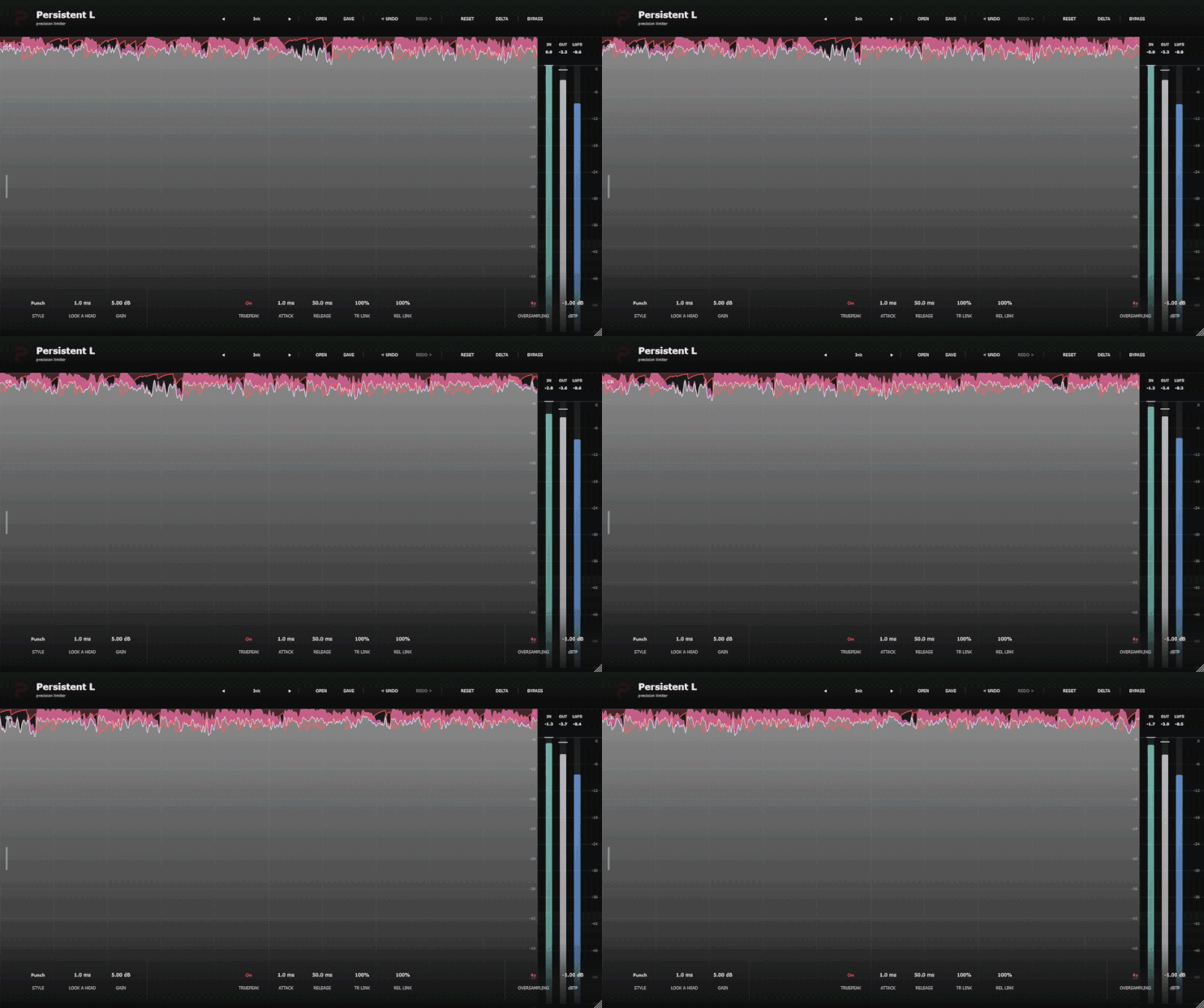
Persistent L : Introduction
Among all dynamics processors used in modern audio production, the limiter occupies a unique position.
Equalizers shape tonal balance.
Compressors influence dynamic behavior.
Reverbs create spatial depth.
Saturators introduce harmonic complexity.
Limiters, however, often perform the final stage of signal control before audio leaves the production environment and reaches the listener.
For this reason, the limiter is frequently one of the most influential processors in an entire signal chain.
A single decibel of additional limiting can alter the perceived loudness, punch, density, clarity, and emotional impact of a mix. At the same time, excessive limiting can quickly introduce undesirable side effects, reducing transient definition, flattening musical dynamics, and creating audible distortion.
The challenge of limiting is therefore not merely controlling level.
The challenge is controlling level without compromising the musical qualities that make the material engaging in the first place.
To understand this challenge, it is useful to examine the role of a limiter within the broader context of dynamics processing.
A limiter is fundamentally a specialized form of dynamic range control.
Like a compressor, it reduces signal level when the incoming audio exceeds a defined threshold. The primary distinction lies in the aggressiveness of the gain reduction process. While a conventional compressor may apply gradual attenuation through moderate ratios, a limiter operates with extremely high ratios, effectively preventing signals from exceeding a specified ceiling.
In practical terms, a limiter functions as a protective boundary.
When the incoming signal attempts to exceed that boundary, gain reduction is applied rapidly enough to prevent unwanted peaks from passing through.
Historically, limiters were often used for technical protection.
Broadcast systems employed limiters to prevent transmission overloads. Recording systems used them to avoid clipping. Digital production environments relied upon them to ensure that signals remained within available headroom.
Modern production workflows have expanded this role considerably.
Today, limiters are not used solely for protection.
They are also used for loudness optimization.
As audio production evolved, engineers discovered that carefully controlled limiting could increase perceived loudness without necessarily increasing peak level. By reducing transient peaks and redistributing available headroom, average signal level could be raised while remaining within technical limits.
This principle became a central component of modern mastering.
The relationship between peak level and perceived loudness is not always intuitive.
Two mixes may reach exactly the same peak level while exhibiting dramatically different perceived loudness. Peak measurements describe the highest instantaneous level reached by a signal. Loudness measurements attempt to quantify how loud the signal is perceived over time.
Because human hearing integrates energy across time rather than responding solely to instantaneous peaks, loudness and peak level are related but not identical concepts.
This distinction creates one of the central challenges of mastering.
Increasing loudness typically requires reducing peak-to-average ratio.
However, the very transients responsible for creating punch, impact, and excitement are often the same transients that consume the greatest amount of available headroom.
Every decibel of additional loudness therefore involves a decision.
How much transient information can be reduced before the character of the music begins to change?
This question has shaped decades of audio production.
During the period commonly referred to as the Loudness War, commercial releases were often mastered at increasingly aggressive levels in pursuit of competitive loudness. While this approach frequently produced louder masters, it also exposed the limitations of conventional limiting techniques.
Excessive gain reduction could lead to transient smearing, pumping artifacts, distortion, listener fatigue, and loss of musical depth.
The pursuit of loudness revealed an important truth.
The objective of a limiter is not maximum attenuation.
The objective is transparent attenuation.
An ideal limiter should reduce peaks without drawing attention to itself.
Listeners should perceive the music, not the process.
Achieving this goal is considerably more difficult than it may initially appear.
A limiter must react quickly enough to control peaks before clipping occurs. At the same time, it must avoid creating abrupt gain changes that introduce distortion or alter the natural envelope of the source material.
If the response is too slow, peaks may escape.
If the response is too fast, the gain reduction process itself may become audible.
The balance between control and transparency defines the art of limiting.
The transition from analog to digital production introduced additional considerations.
Within digital systems, clipping occurs abruptly once available headroom has been exhausted. Unlike many analog systems, digital overload generally produces highly audible artifacts that are rarely considered desirable.
As playback systems, streaming platforms, and distribution formats evolved, engineers became increasingly aware of another challenge: intersample peaks.
Although a digital waveform may appear to remain below 0 dBFS, the reconstructed analog signal produced during playback can occasionally exceed that level. These overs may not be visible within conventional sample-based metering but can nevertheless create distortion during conversion and playback.
This phenomenon led to the development of True Peak measurement and True Peak limiting.
Rather than evaluating individual digital samples alone, True Peak systems estimate the behavior of the reconstructed waveform, providing a more accurate representation of real-world playback conditions.
Today, reliable peak management requires consideration of both sample peaks and reconstructed analog peaks.
Modern limiting therefore extends beyond simple peak reduction.
The process now encompasses loudness management, transient preservation, true peak protection, stereo consistency, oversampling accuracy, and final delivery preparation.
A limiter is no longer merely a safety device.
It is a critical component of modern mastering architecture.
Persistent L was developed around this understanding.
The objective was not to create a limiter that simply produces louder output.
The objective was to create a system capable of controlling peaks with precision while preserving the musical integrity of the source material.
Within Persistent L, peak management, true peak protection, loudness monitoring, oversampling, dithering, and delivery preparation are integrated into a unified workflow. Every component is designed around the same principle: maintaining control without sacrificing transparency.
This philosophy extends to both the visual and sonic aspects of the processor.
Limiting is often treated as an invisible process, leaving engineers to infer what is happening through numerical values alone. Persistent L instead provides direct insight into gain reduction behavior, waveform evolution, loudness development, and output integrity, allowing decisions to be based on observation as well as listening.
The ultimate purpose of a limiter is not to make audio louder.
Its purpose is to determine how a finished production occupies the final boundaries of available headroom.
Persistent L approaches this responsibility as both a technical and musical task. Peak control, loudness optimization, transient preservation, and output reliability are treated not as separate objectives, but as interconnected aspects of the same process.
Understanding these principles provides the foundation for the chapters that follow. The next section examines the relationship between True Peak measurement and loudness management, exploring how modern limiters interact with the technical requirements and listening expectations of contemporary audio distribution.