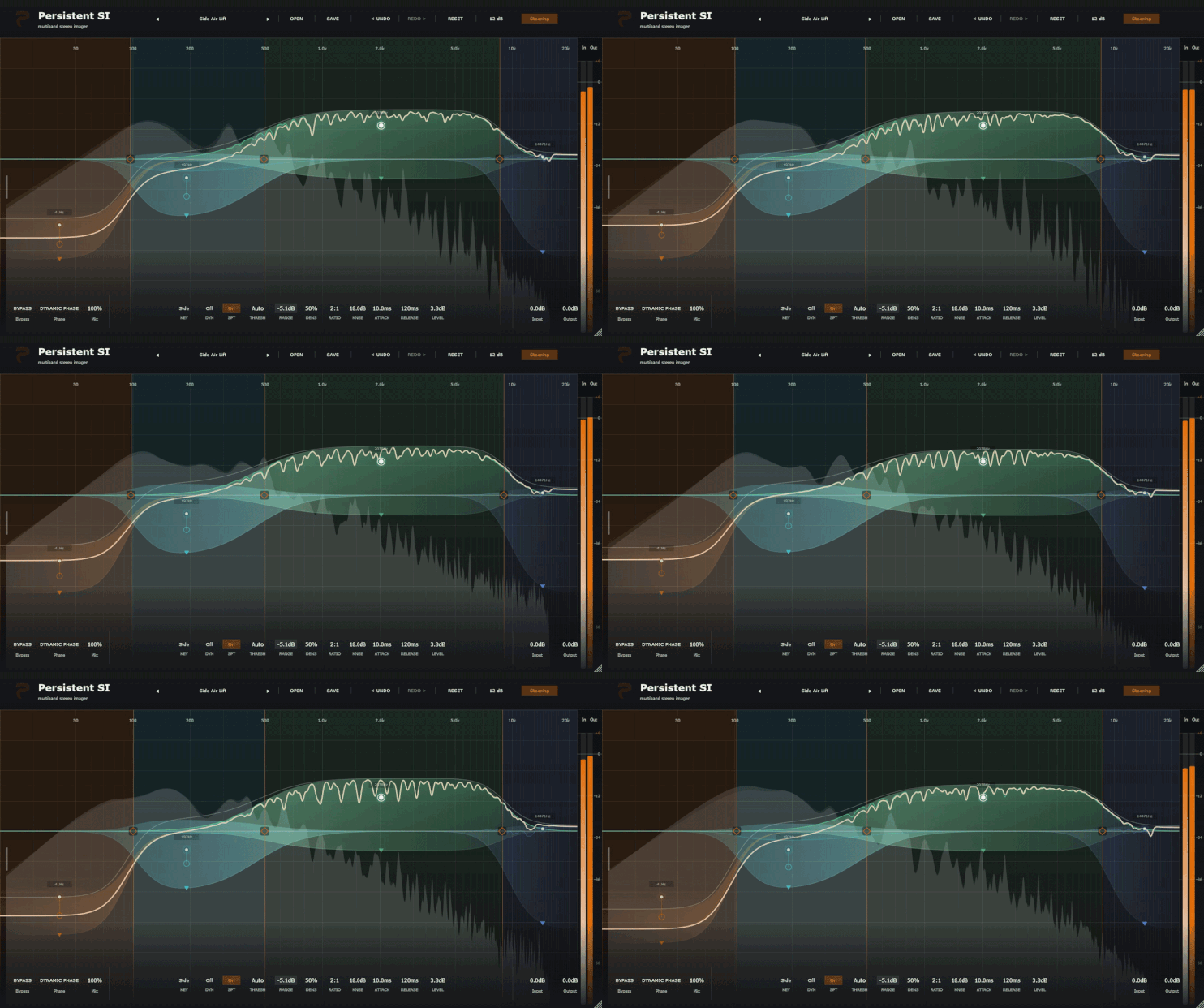
Persistent SI : Auto Steering
Spatial balance is rarely static.
Even within a carefully constructed mix, the relationship between Mid and Side information is constantly changing. Instruments enter and leave the arrangement. Harmonic content evolves. Transients emerge, decay, and disappear. The density of the mix shifts from section to section, and the frequencies that dominate the stereo image at one moment may be entirely different only seconds later.
This continuous movement is a natural consequence of music.
A stereo image is not a fixed object.
It is a dynamic structure shaped by the interaction of frequency, energy, performance, arrangement, and production decisions.
Traditional stereo imaging systems generally assume otherwise.
Once width settings have been established, processing remains fixed regardless of what happens within the source material. A low-frequency band retains the same spatial relationship throughout the entire performance. A high-frequency band maintains the same width regardless of whether the signal contains subtle ambience or intense transient activity.
While this approach provides predictability, it also introduces an important limitation.
The optimal spatial balance of a mix is rarely identical from one moment to the next.
A chorus may benefit from greater openness than a verse.
A sparse arrangement may require different spatial emphasis than a dense one.
A vocal passage may demand stronger center focus, while an instrumental section may allow additional expansion.
The challenge is not determining the ideal stereo image.
The challenge is maintaining an appropriate stereo image as the music evolves.
Persistent SI addresses this problem through Auto Steering.
Auto Steering is an adaptive spatial control system designed to analyze the ongoing relationship between Mid and Side energy across the frequency spectrum and respond according to a defined spatial objective. Rather than treating stereo imaging as a collection of permanently fixed settings, the system continuously evaluates how the musical content is distributed and adjusts its behavior accordingly.
The purpose of Auto Steering is not automation for its own sake.
Its purpose is to preserve spatial intent.
When an engineer configures a multiband stereo image, every decision reflects a desired relationship between focus and width. Certain frequency regions may be intended to remain stable and centered. Others may be designed to contribute openness and dimensionality. Some bands may be expected to expand dynamically, while others serve as anchors within the stereo field.
As the spectral structure of the music changes, these relationships may become increasingly difficult to maintain through static processing alone.
Auto Steering provides a mechanism through which the processor can remain aware of those changes.
The system continuously evaluates the energy distribution within each frequency region and interprets how that distribution relates to the overall spatial structure of the mix. Based on the selected steering behavior, adjustments can be made to maintain a more consistent balance between width, focus, and perceived dimensionality.
Within Persistent SI, this process extends beyond simple width control.
The steering system can influence multiple aspects of the imaging architecture, including crossover behavior, band emphasis, and the operational range of Dynamic and Spectral processing systems.
This distinction is important.
Auto Steering is not merely widening or narrowing the stereo field.
It is managing how spatial responsibilities are distributed throughout the spectrum.
As the musical content changes, the relative importance of different frequency regions may change as well.
A static crossover configuration assumes that spatial boundaries remain equally relevant throughout the entire performance.
In reality, the frequencies carrying the most important spatial information often shift over time.
By allowing crossover regions to adapt, Auto Steering can maintain a more meaningful separation between frequency bands as the spectral balance of the source evolves.
Similarly, the significance of individual bands may change throughout a mix.
A frequency region that contributes strongly to width during one passage may become less important during another. Auto Steering can respond to these variations by adjusting band emphasis and processing intensity, helping maintain a coherent spatial structure without requiring constant manual intervention.
This adaptive philosophy becomes particularly valuable in complex productions.
Modern mixes often contain hundreds of simultaneous spectral interactions. Vocals compete with instruments. Reverb tails interact with transient material. Synthesizers, guitars, percussion, and ambience continuously alter the balance between Mid and Side energy.
Attempting to optimize spatial relationships manually for every moment of a production would be both impractical and time-consuming.
Auto Steering provides a means of assisting this process while preserving the engineer's original intent.
The system does not replace creative decision-making.
The user remains responsible for defining the desired spatial direction of the mix.
Auto Steering simply helps maintain that direction as the material evolves.
A defining characteristic of Persistent SI is that Auto Steering is guided through a collection of specialized Steering Styles.
These styles are not conventional presets.
A preset typically stores parameter values.
A Steering Style stores behavioral philosophy.
Each style represents a different interpretation of spatial balance, movement, and energy distribution.
Some styles prioritize stability and center focus.
Others emphasize openness and expansion.
Certain styles react aggressively to changing spatial information, while others operate more gradually and conservatively.
The selected style influences how the processor interprets Mid and Side relationships throughout the spectrum and how it responds to changes within the incoming material.
Because musical objectives vary significantly between genres, production techniques, and mixing environments, no single steering behavior can be considered universally correct.
A mastering engineer may seek consistency and restraint.
An electronic music producer may prefer movement and expansion.
An orchestral recording may require a very different spatial philosophy than a modern pop production.
The availability of multiple Steering Styles allows the adaptive behavior of the processor to be aligned with the artistic goals of the project rather than forcing every production into the same spatial framework.
This design philosophy reflects a broader principle that appears throughout the Persistent Series.
Adaptive processing should not remove control from the engineer.
It should enhance the engineer's ability to achieve and maintain a desired result.
Auto Steering therefore functions as an intelligent assistant rather than an autonomous decision-maker.
The engineer defines the destination.
The steering system helps maintain the trajectory.
Within Persistent SI, stereo imaging is no longer treated as a collection of fixed width controls distributed across multiple frequency bands. The stereo field becomes a living structure capable of responding to changing musical conditions while preserving a coherent spatial identity.
Multiband Imaging defines how space is organized across the spectrum.
Dynamic and Spectral processing determine how that space responds to energy and resonance.
Auto Steering ensures that the entire system remains connected to the evolving musical content it is designed to support.
The result is a stereo imaging workflow that is not only frequency-aware, but context-aware-capable of adapting to the movement, density, and character of a performance while maintaining the spatial intent established by the engineer.