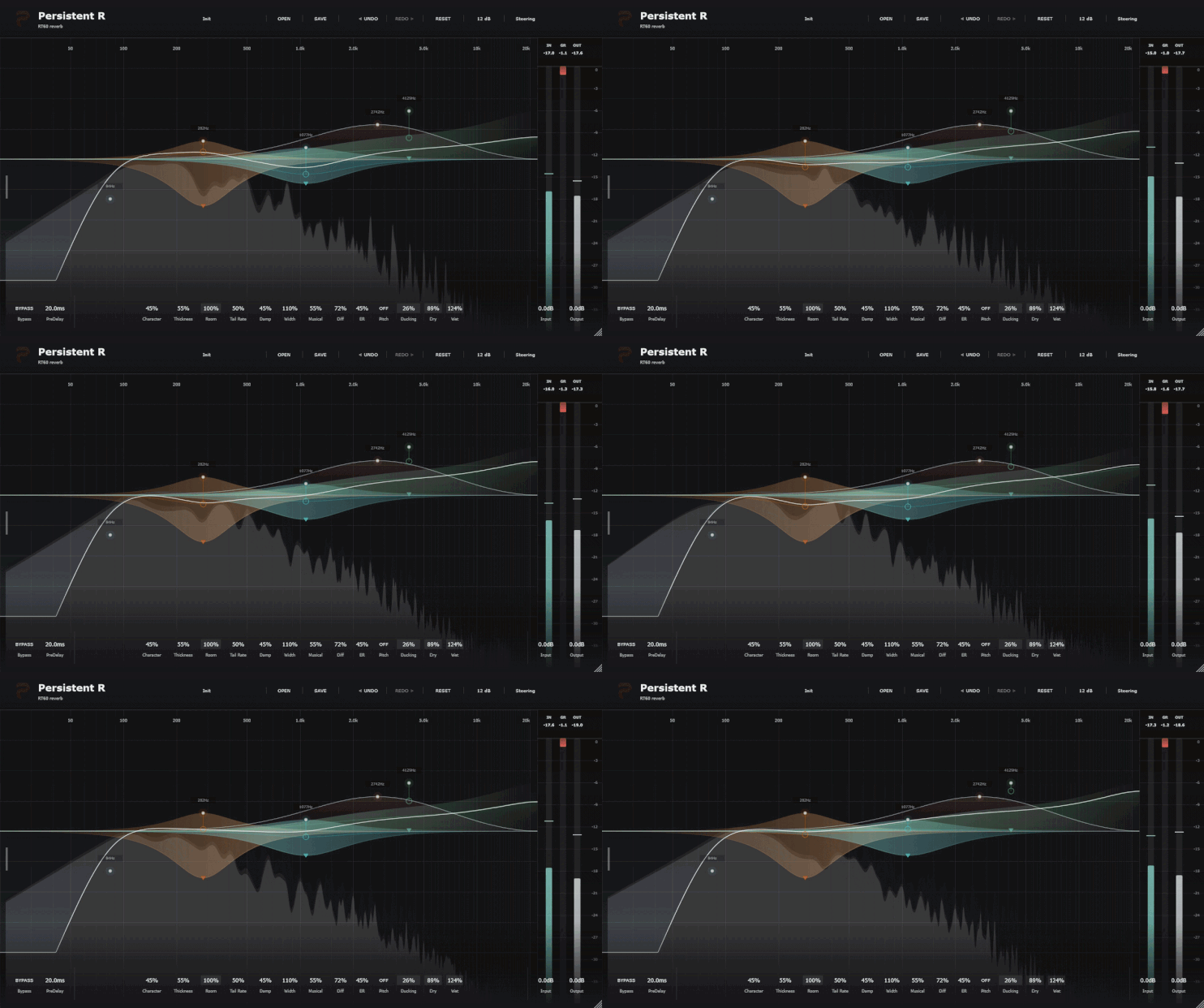
Persistent R : Introduction to Reverb
Reverberation is one of the most fundamental phenomena in acoustics. Unlike equalization, which modifies spectral balance, or compression, which controls dynamic range, reverb is concerned with the perception of space. It influences how listeners interpret distance, size, depth, environment, and spatial relationships within an audio scene.
Every sound heard in a physical environment exists within an acoustic space. Whether the source is a voice in a small room, a piano in a concert hall, or a drum kit in a studio, the listener rarely hears only the direct sound produced by the source itself. Instead, the direct sound is accompanied by countless reflections generated as acoustic energy interacts with surrounding surfaces.
These reflections form the basis of reverberation.
When a sound is produced within an enclosed space, acoustic energy radiates outward in all directions. Some of this energy travels directly to the listener, while the remainder is reflected by walls, ceilings, floors, and other objects within the environment. Each reflection arrives at a slightly different time and with a slightly different spectral balance depending on the properties of the reflecting surfaces and the distance traveled.
As the number of reflections increases, individual reflections become increasingly difficult to distinguish. Eventually they merge into a dense and continuously decaying acoustic field commonly referred to as the reverb tail.
The human auditory system uses this information to infer characteristics of the surrounding environment.
The timing of reflections contributes to the perception of size. The density of reflections influences the perception of enclosure and diffusion. The decay characteristics of the reverberant field provide cues regarding room volume and surface absorption. Spectral changes within the decay influence the perceived brightness, warmth, and material composition of the space.
For this reason, reverb serves a dual purpose in audio production.
From a technical perspective, it recreates the acoustic behavior of physical spaces. From an artistic perspective, it functions as a compositional and mixing tool capable of shaping emotional impact, depth, atmosphere, and spatial perspective.
The structure of a reverberant field is commonly divided into several components.
The first component is the direct sound, representing the unreflected signal arriving from the source.
Following the direct sound are the early reflections. These reflections arrive shortly after the direct signal and are often perceived as distinct spatial cues rather than as part of the diffuse reverberant field. Early reflections contribute significantly to the perception of room size, source position, and environmental realism.
As reflection density increases, the acoustic field transitions into late reverberation. At this stage, individual reflections are no longer perceived independently. Instead, the listener perceives a continuous decay of acoustic energy extending over time.
The duration of this decay is often described using RT60.
RT60 represents the time required for the reverberant field to decay by 60 decibels after the source has stopped producing sound. Although originally developed as a measurement of physical acoustic spaces, RT60 has become one of the most widely used parameters in artificial reverb design.
Short RT60 values generally produce the perception of smaller or more acoustically controlled environments. Longer RT60 values create the impression of larger spaces with greater reverberant energy and extended sustain.
The temporal structure of a reverb is influenced by several additional parameters.
PreDelay defines the time interval between the arrival of the direct sound and the onset of reverberation. By separating the source from its reverberant field, PreDelay can increase intelligibility and create the perception of greater depth without necessarily increasing overall decay time.
Diffusion influences the density and distribution of reflections within the reverb tail. Low diffusion settings tend to produce more discrete and identifiable reflections, while higher diffusion values create smoother and more continuous reverberant fields.
Early Reflection control determines the prominence of the initial reflection structure relative to the later portions of the decay. Adjusting this balance can significantly alter the perceived character of a space.
Stereo Width influences the spatial distribution of reverberant energy across the stereo field. Narrow settings concentrate the reverberation toward the center, while wider settings expand the perceived dimensions of the acoustic environment.
Damping controls the frequency-dependent decay characteristics of the reverb. In natural environments, high frequencies typically decay more rapidly than low frequencies due to air absorption and surface interactions. Damping systems allow this behavior to be reproduced and adjusted within artificial reverberation algorithms.
These controls provide a framework for constructing acoustic environments, but effective reverb design extends beyond the simulation of physical spaces.
In modern music production, reverberation is frequently used as a creative tool rather than a purely realistic one. Artificial reverbs may exaggerate room size, manipulate decay behavior, alter spectral balance, introduce modulation, or generate spatial effects that do not exist within physical acoustics.
As a result, contemporary reverbs often occupy a position somewhere between acoustic simulation and sound design.
The practical application of reverb requires balancing spatial enhancement against clarity. Excessive reverberation can obscure transient detail, reduce intelligibility, and introduce frequency masking. Insufficient reverberation may result in a mix that feels dry, disconnected, or lacking depth.
Successful reverb design therefore involves more than selecting an appropriate room size or decay time. It requires consideration of frequency content, source placement, stereo image, dynamic interaction, and the overall spatial architecture of a mix.
Modern reverb processors increasingly incorporate tools intended to address these challenges. Dynamic processing, frequency-dependent decay control, adaptive equalization, spectral shaping, and intelligent spatial management have expanded the capabilities of reverb far beyond traditional room simulation.
Persistent R was developed within this context.
While grounded in the acoustic principles that define reverberation, Persistent R extends conventional reverb design through dynamic processing, adaptive frequency control, spectral shaping, and responsive spatial behavior. Rather than treating reverb as a static environment, it provides tools for constructing spaces that evolve in response to both the source material and the requirements of the mix.
Understanding the acoustic principles discussed in this chapter provides the foundation for exploring the advanced spatial processing systems introduced throughout the remainder of this series.