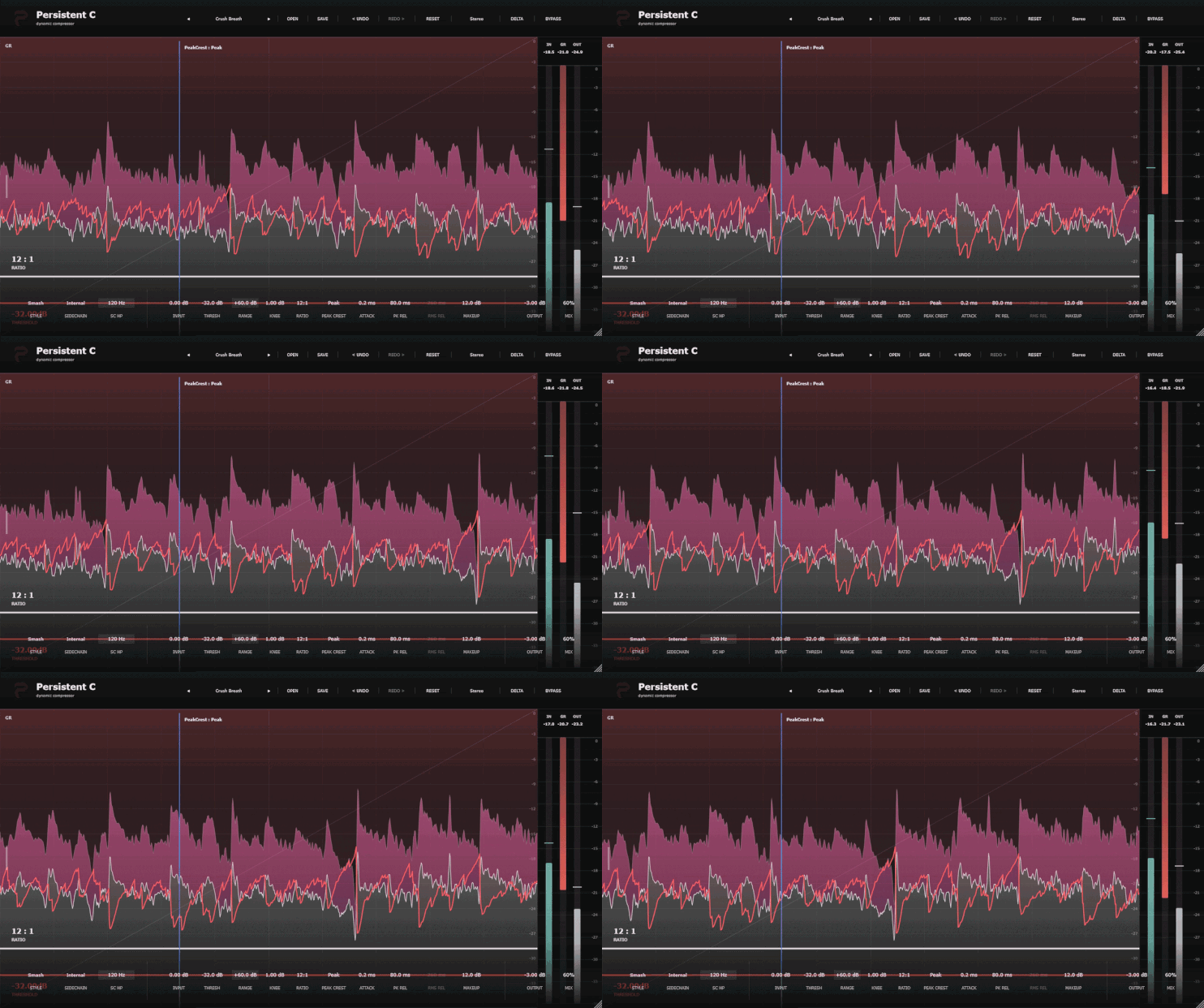
Persistent C : Dual Stage Timing Control
The behavior of a compressor is determined not only by how much gain reduction is applied, but also by how quickly that gain reduction occurs.
Two compressors configured with identical threshold and ratio settings may produce dramatically different results if their attack and release characteristics differ. In many cases, timing parameters exert a greater influence on the perceived character of compression than the amount of gain reduction itself.
For this reason, attack and release controls have traditionally occupied a central role in compressor design.
Attack defines the rate at which gain reduction increases after the input signal exceeds the threshold. Release defines the rate at which gain reduction returns toward unity gain after the signal falls below the threshold. Together, these parameters determine the temporal behavior of the gain control system.
Although this model has proven effective for decades, it is ultimately based on a simplified assumption: a single timing structure is sufficient to describe the dynamic behavior of a signal.
In practice, musical material often contains multiple layers of dynamic activity occurring simultaneously.
A drum hit may contain a transient lasting only a few milliseconds followed by a sustain portion extending hundreds of milliseconds. A vocal performance may exhibit rapid syllabic variations alongside longer phrases that evolve over several seconds. A bass guitar may contain sharp note attacks while also generating slow fluctuations in overall energy.
These events occur on different time scales.
A single attack and release system must therefore attempt to manage both short-term and long-term dynamic behavior at the same time.
This often leads to compromise.
Fast timing settings may effectively control transient peaks but can introduce excessive gain modulation during sustained material. Slow timing settings may provide smooth overall control while allowing unwanted peaks to pass unaffected.
The challenge arises because different components of the signal require different temporal responses.
To address this limitation, modern dynamic processors increasingly employ multi-stage timing architectures.
Rather than relying on a single attack and release trajectory, multiple timing structures are combined to produce a more flexible gain reduction behavior.
Persistent C implements this concept through Dual Stage Timing Control.
The system introduces a secondary timing layer operating alongside the primary attack and release structure. While the primary stage establishes the fundamental response of the compressor, the secondary stage provides an additional level of temporal shaping that can influence how gain reduction develops over longer or more complex time intervals.
This architecture allows the compressor to respond simultaneously to both short-duration events and slower changes in signal energy.
The primary Attack and Release controls continue to define the immediate reaction of the compressor. These parameters determine how rapidly gain reduction begins and how quickly it recovers under normal operating conditions.
The secondary timing stage extends this behavior.
Sec Attack defines the response rate of the secondary stage as gain reduction develops beyond the initial compression event. Rather than affecting the earliest portion of the attack phase, it influences the evolution of compression over a longer time scale.
Sec Release performs a similar role during recovery. While the primary release determines the initial return toward unity gain, the secondary release contributes an additional recovery characteristic that can extend or reshape the release trajectory.
The interaction between these timing structures creates a more complex dynamic response than would be possible using a single-stage design.
An additional parameter, Attack Mix, determines the relative contribution of the primary and secondary attack systems.
By adjusting this relationship, the engineer can control how strongly the secondary timing structure influences the overall compression behavior. The result is a continuously variable transition between predominantly single-stage operation and more pronounced dual-stage behavior.
The practical significance of this approach becomes evident when processing signals containing both transient and sustained components.
Consider a drum bus.
The transient attack of each drum hit may require rapid control to prevent excessive peak levels. At the same time, the overall energy of the performance may benefit from a slower and more gradual compression characteristic. A conventional compressor must balance these requirements using a single timing structure.
Dual Stage Timing Control allows both behaviors to coexist.
The primary stage can react quickly enough to manage transient peaks, while the secondary stage contributes a slower and more stable response to longer-term energy variations.
A similar advantage exists when processing vocals.
Speech and singing contain dynamic information across multiple time scales. Individual consonants and syllables may require immediate control, while phrase-level dynamics often benefit from smoother and more gradual gain reduction. Dual-stage timing allows these behaviors to be addressed simultaneously without forcing a compromise between responsiveness and transparency.
Bus compression provides another useful example.
One of the objectives of bus compression is often to increase cohesion among multiple sources. Excessively fast timing can create audible pumping and modulation, while excessively slow timing may reduce the effectiveness of the compression process. By combining timing stages, it becomes possible to retain responsive peak control while maintaining a more natural long-term gain envelope.
From a signal-processing perspective, Dual Stage Timing Control can be viewed as an extension of the compressor's envelope generation system.
Traditional compressors generate a single control envelope derived from the detector signal. Dual-stage systems generate a more sophisticated control structure by combining multiple envelope trajectories, each operating on different temporal scales.
The resulting gain reduction behavior more closely reflects the complexity of real-world musical signals.
Importantly, Dual Stage Timing Control does not simply make compression faster or slower.
Its purpose is to separate different categories of dynamic behavior and allow each to be managed according to its own time scale. Short-duration events and long-duration energy changes no longer need to share a single timing response.
This distinction provides greater flexibility while preserving predictability.
Engineers can shape the immediate impact of a sound independently from its longer-term dynamic contour, allowing compression to be tailored more precisely to the characteristics of the source material.
Within Persistent C, Dual Stage Timing Control forms a natural extension of the Crest Factor Based Control system discussed in the previous chapter.
Crest Factor Based Control influences which components of the signal drive the detector. Dual Stage Timing Control influences how the compressor reacts once those components have been detected.
Together, these systems expand dynamic processing beyond conventional threshold, ratio, attack, and release adjustment. Rather than treating all dynamic events identically, Persistent C provides independent control over both the structure of the detected signal and the temporal behavior of the resulting gain reduction, allowing compression to adapt more effectively to the complexity of modern audio material.