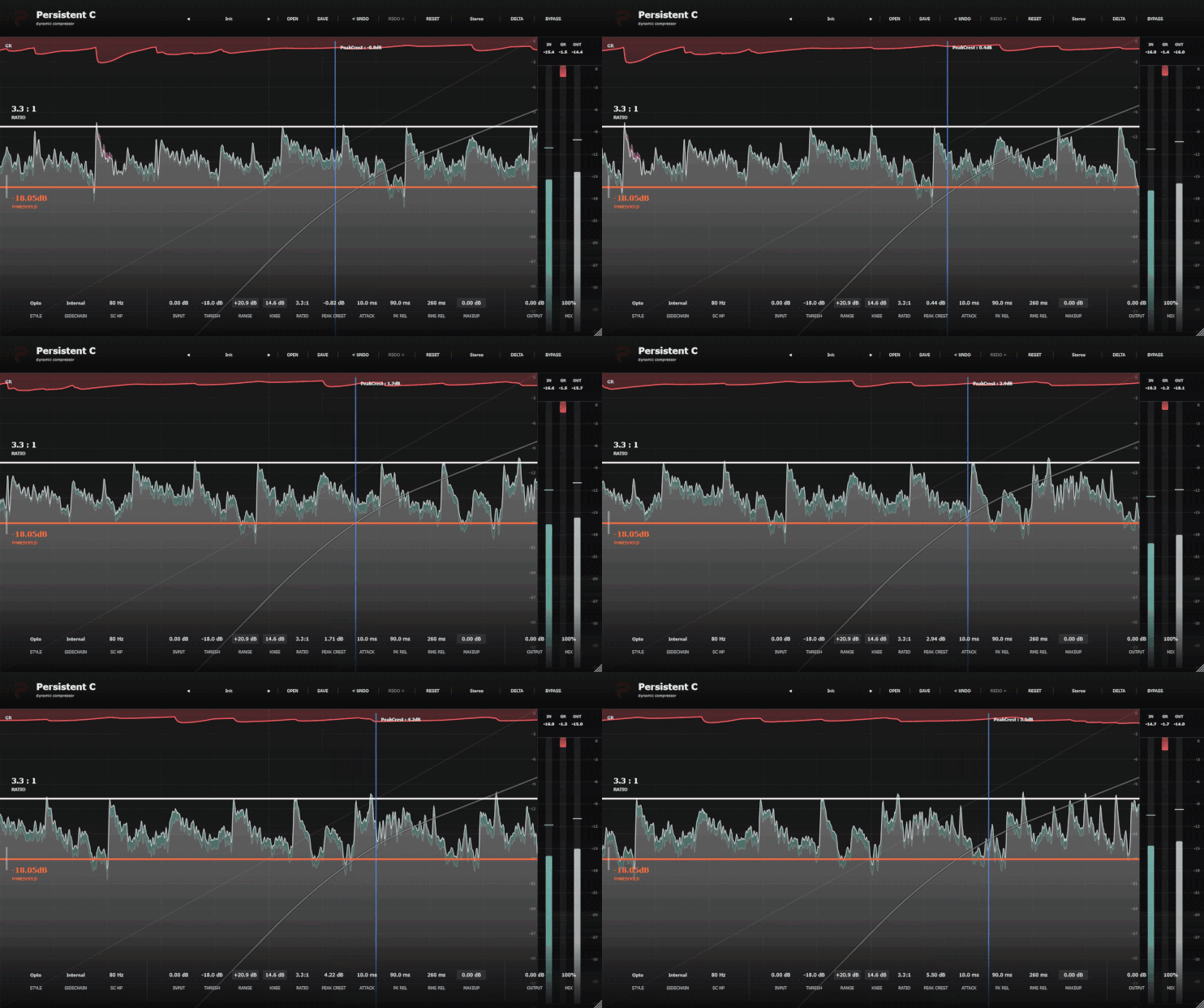
Persistent C : Crest Factor Based Control
A compressor responds to level.
While this statement is fundamentally correct, it introduces an important question: which level?
An audio signal can be measured in multiple ways, and different measurement methods often describe different aspects of the same sound. A short transient drum hit and a sustained pad may produce similar peak values while exhibiting dramatically different average energy. Likewise, two signals with identical RMS levels may possess completely different transient characteristics.
Understanding this distinction is essential for understanding modern dynamic processing.
Historically, compressor designs have relied on different detection methods to determine how gain reduction should be applied. Some compressors primarily respond to peak information, while others operate according to average signal energy. The behavior of the compressor is influenced significantly by the characteristics of the detection system, often as much as by the gain reduction stage itself.
Peak measurement represents the highest instantaneous amplitude within a signal.
Because peak detection reacts rapidly to short-duration events, it is particularly effective for controlling transient material such as drum attacks, percussive instruments, and sudden level excursions. Peak-based compressors tend to respond quickly and can provide precise control over transient peaks that might otherwise overload downstream stages.
RMS measurement operates differently.
Rather than focusing on instantaneous amplitude, RMS estimation measures average signal energy over time. This produces a response that more closely reflects perceived loudness and sustained signal content. RMS-based compressors often sound smoother because they react less aggressively to brief transient events and place greater emphasis on the overall energy of the signal.
Both approaches provide valuable information, yet neither describes the complete dynamic behavior of a sound.
Many musical signals contain a complex relationship between transient peaks and sustained energy. The attack of a snare drum, the pluck of a bass string, the articulation of a vocal consonant, and the strike of a piano hammer all generate transient components that exist alongside longer-duration energy structures.
The relationship between these components is commonly described through Crest Factor.
Crest Factor represents the difference between peak level and average signal level. In practical terms, it describes how transient or sustained a signal is.
Signals with high crest factors contain prominent peaks relative to their average energy. Percussion, acoustic instruments, and highly dynamic performances frequently exhibit this characteristic.
Signals with low crest factors contain less distinction between peaks and average level. Distorted guitars, heavily compressed material, and many modern production elements often fall into this category.
The crest factor of a signal significantly influences how compression is perceived.
A compressor that primarily responds to peak information may aggressively control transient events while leaving average energy relatively unchanged. Conversely, a compressor that focuses on RMS energy may preserve transient detail while shaping the longer-term dynamic envelope.
Neither approach is inherently superior. Each emphasizes a different aspect of the signal.
The challenge arises when both behaviors are required simultaneously.
In many situations, engineers wish to control transient peaks without excessively reducing sustained energy. In other cases, overall dynamic consistency may be desirable while preserving the impact and articulation provided by transient content.
Traditional compressor architectures often require a compromise between these objectives.
Persistent C addresses this challenge through Crest Factor Based Control.
Rather than treating dynamic behavior as a single measurement problem, Persistent C separates the relationship between transient and sustained energy into independently controllable elements. This is achieved through the PeakCrest system, which adjusts the relative behavior of peak-sensitive and RMS-sensitive detection paths.
The PeakCrest parameter modifies the threshold relationship between these detection structures, allowing the compressor to emphasize either transient control or average-energy control depending on the intended result.
Lower PeakCrest values increase sensitivity to transient activity.
Under these conditions, gain reduction is influenced more strongly by short-duration peaks. Compression becomes more immediate and assertive, producing tighter transient control and a more aggressive dynamic character.
This behavior is particularly useful when managing material with pronounced transient content. Drums, percussion, picked instruments, and other highly articulated sources often benefit from enhanced peak control while maintaining overall level consistency.
Higher PeakCrest values shift the compressor's emphasis toward sustained signal energy.
The detector becomes less influenced by brief transient events and increasingly focused on average signal content. Compression tends to sound smoother, more transparent, and more stable over time.
This approach is often desirable for vocals, buses, pads, orchestral material, and mastering applications where preserving transient integrity is important while maintaining consistent long-term dynamics.
The practical significance of Crest Factor Based Control extends beyond simple peak management.
Because transient energy contributes strongly to perceived punch, attack, and articulation, altering the relationship between peak and RMS detection effectively changes how a source occupies space within a mix. Two signals may exhibit identical gain reduction values while producing noticeably different subjective results depending on how the compressor interprets transient information.
This distinction becomes especially important when processing complex material.
A bass guitar may require control over occasional transient spikes while retaining its sustained low-frequency foundation. A vocal performance may benefit from consistent energy control without excessive suppression of consonants and articulation. A drum bus may require a balance between impact and cohesion rather than exclusively favoring either characteristic.
Crest Factor Based Control provides a means of shaping these relationships directly.
Rather than relying solely on attack and release parameters to influence compressor behavior, the engineer can modify the detector's interpretation of the signal itself. The resulting control operates at a more fundamental level, affecting how the compressor perceives dynamic information before gain reduction decisions are made.
Within Persistent C, PeakCrest serves as a bridge between traditional peak-based and RMS-based compression philosophies. It allows dynamic behavior to be positioned along a continuum rather than constrained to a single detection method.
The objective is not simply to compress more or compress less.
The objective is to determine which aspects of the signal should drive the compression process.
By controlling the relationship between transient peaks and sustained energy, Crest Factor Based Control expands the range of dynamic behaviors available within a single compressor architecture. This enables more precise adaptation to different source materials, production styles, and artistic objectives while maintaining a consistent and predictable workflow.
Persistent C incorporates this approach as a central component of its dynamic processing philosophy, allowing engineers to move beyond conventional threshold and ratio adjustments and directly influence how the compressor interprets the structure of the incoming signal itself.