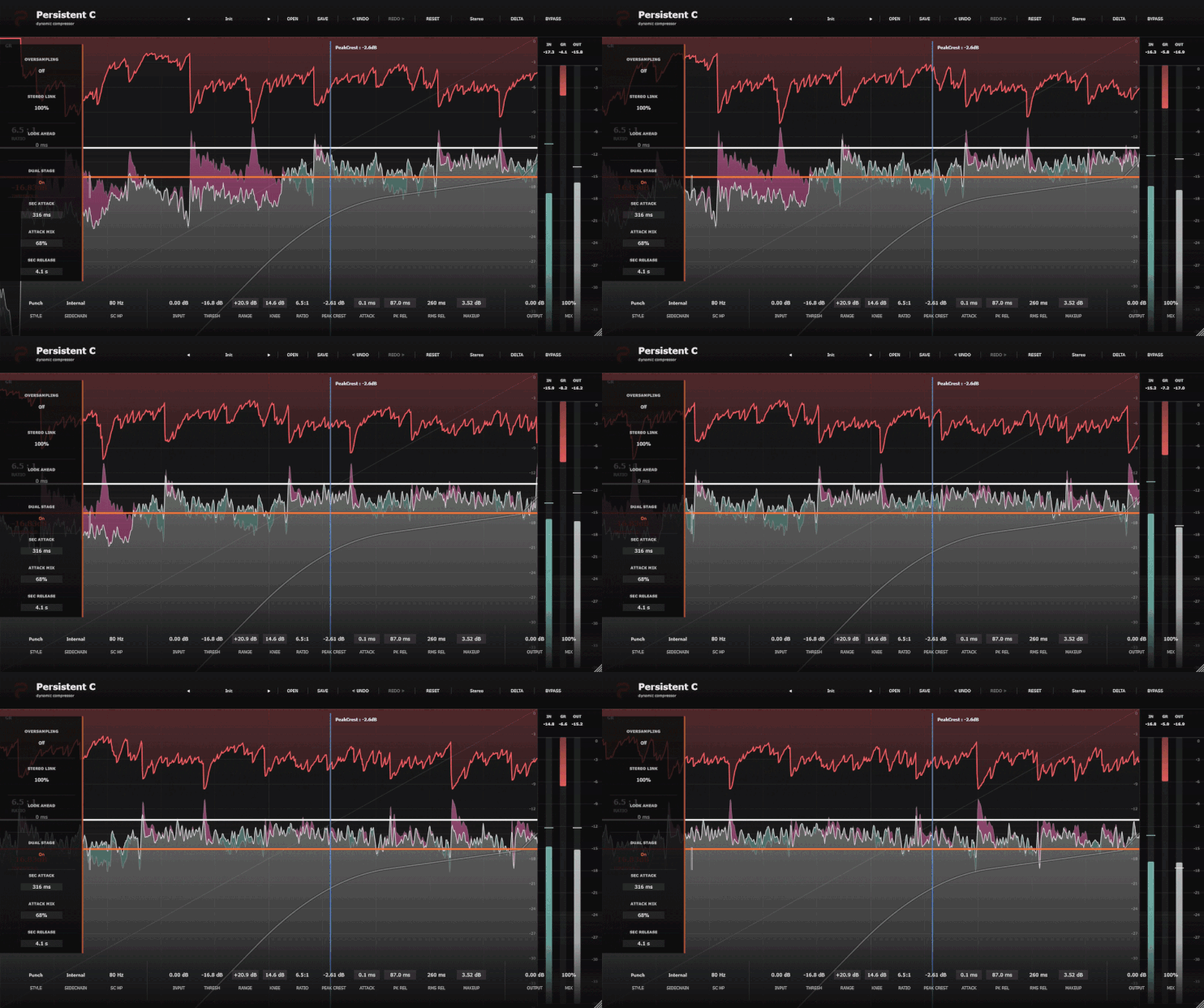
Persistent C : Introduction to Compression
Dynamic range is one of the most important characteristics of an audio signal. It describes the difference between the quietest and loudest portions of a sound and plays a significant role in how that sound is perceived. A whispered vocal phrase, a forceful drum hit, the attack of a piano note, and the sustain of a bass guitar all contribute to the dynamic structure of a recording.
In natural acoustic environments, dynamic variation is an essential part of musical expression. However, excessive dynamic range can create practical challenges during recording, mixing, and mastering. Signals that are too dynamic may become difficult to balance within a mix, while sudden peaks can reduce available headroom and compromise overall level management.
Compression was developed as a method of controlling these dynamic variations.
At its most fundamental level, a compressor is a level-dependent processor that reduces gain when the input signal exceeds a specified threshold. By attenuating louder portions of a signal while leaving quieter portions relatively unaffected, compression reduces dynamic range and increases overall level consistency.
Although this definition appears straightforward, the practical applications of compression extend far beyond simple level reduction.
Compression influences perceived loudness, transient response, sustain characteristics, tonal balance, rhythmic movement, and spatial perception. As a result, it has become one of the most versatile and widely used processes in modern audio production.
The operation of a compressor is typically defined through a small set of interconnected parameters.
Threshold determines the signal level at which compression begins. Signals below the threshold pass unaffected, while signals exceeding the threshold become subject to gain reduction.
Ratio determines the amount of gain reduction applied once the threshold has been exceeded. Higher ratios produce more aggressive dynamic control, while lower ratios result in gentler compression. At sufficiently high settings, compression approaches limiting behavior, where increases in input level produce little or no corresponding increase in output level.
The transition between uncompressed and compressed regions is governed by the Knee characteristic. A hard knee introduces compression immediately upon reaching the threshold, while a soft knee gradually increases compression as the signal approaches and exceeds the threshold. Soft knee behavior generally produces smoother and less noticeable gain reduction, particularly on program material with continuously varying dynamics.
Attack and Release define the time-dependent behavior of the gain reduction system.
Attack determines how quickly the compressor responds after the input signal exceeds the threshold. Fast attack times reduce transient energy and create tighter dynamic control, while slower attack times allow initial transients to pass before gain reduction becomes active.
Release determines how quickly the compressor returns to its neutral state after the signal falls below the threshold. Short release times allow rapid recovery but may introduce audible modulation if set excessively fast. Longer release times generally produce smoother operation but can reduce responsiveness during rapidly changing material.
Because compression reduces signal level, a MakeUp Gain stage is commonly included after the gain reduction process. MakeUp Gain restores lost level and allows the compressed signal to be compared more accurately with the original source. This comparison is important because listeners often perceive louder signals as sounding better, even when no actual improvement has occurred.
Understanding individual compressor parameters is only the first step toward understanding compression itself.
A compressor does not respond directly to frequency content, harmonic complexity, or musical intent. It responds to level. However, because level is closely linked to many perceptual aspects of sound, compression frequently produces changes that extend beyond simple gain reduction.
For example, reducing the level of transient peaks can increase the apparent sustain of an instrument. Controlling large dynamic swings can improve intelligibility within a dense mix. Increasing average signal level can alter the perceived energy and presence of a source. These effects are often interpreted as tonal changes despite originating from dynamic processing.
This relationship between dynamics and perception explains why compression is frequently considered both a technical and creative tool.
From a corrective perspective, compression can stabilize inconsistent performances, prevent overload conditions, and improve balance between competing sources. From a creative perspective, it can enhance punch, increase sustain, emphasize groove, shape transient character, and alter the perceived density of a mix.
Different compression strategies emerge depending on the intended objective.
A vocal compressor may be configured to maintain consistent intelligibility throughout a performance. Drum compression may focus on controlling transient peaks while preserving impact. Bus compression often seeks to improve cohesion between multiple sources, while mastering compression is typically used to provide subtle dynamic refinement across an entire mix.
These applications may utilize similar controls, yet the underlying goals can differ significantly.
Historically, compressors have been implemented through a variety of circuit topologies, including optical, VCA, FET, and vari-mu designs. Each topology exhibits unique characteristics arising from its control mechanism and gain reduction behavior. Although modern digital processors are not constrained by the limitations of analog circuitry, many contemporary compressors continue to draw inspiration from these established approaches.
As audio production techniques have evolved, compression has expanded beyond traditional gain reduction. Modern dynamic processors increasingly incorporate adaptive timing systems, frequency-dependent detection, multiband architectures, spectral analysis, and intelligent signal tracking. These developments allow compressors to respond more selectively and transparently to complex audio material.
Despite these advancements, the fundamental objective remains unchanged.
Compression is the controlled management of dynamic range.
Every parameter, detection method, timing characteristic, and processing topology ultimately serves this purpose. The engineer determines how the signal should behave dynamically, and the compressor provides the means to shape that behavior.
Persistent C was developed around this principle. It combines traditional dynamic range control with modern visualization, adaptive processing, and advanced timing architectures, allowing dynamic behavior to be observed, analyzed, and adjusted with greater precision. Understanding the concepts presented in this chapter provides the foundation for exploring the advanced dynamic control systems discussed throughout the remainder of this series.