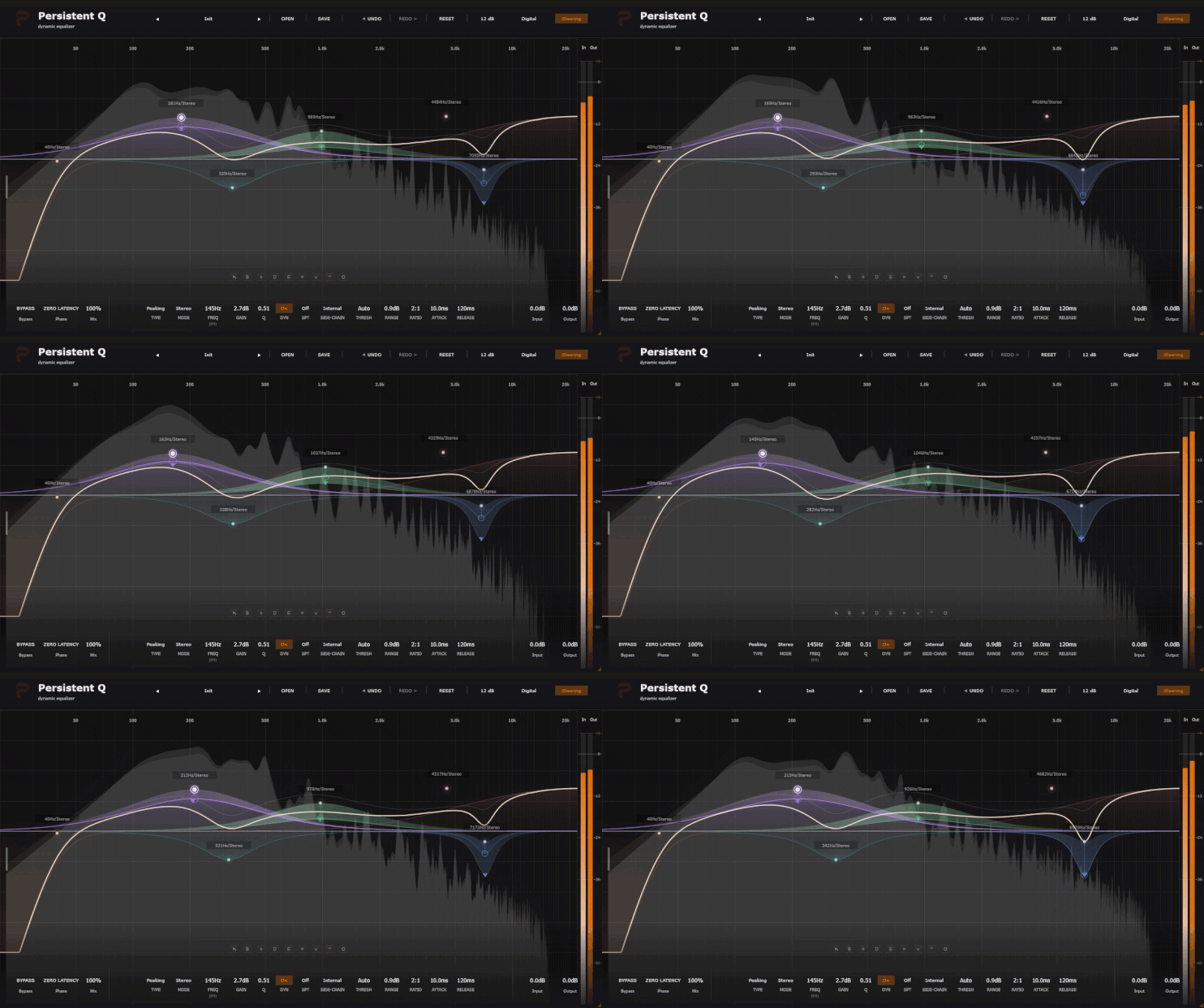
Persistent Q : Auto Steering
Conventional equalization is based upon a fundamental assumption: the frequency of interest remains stationary.
When an engineer identifies a problematic resonance at 800 Hz, a filter is positioned at that frequency and remains there. When additional presence is required at 3 kHz, a boost is applied to that region and remains fixed. The effectiveness of this approach depends on the stability of the spectral content being processed.
In many situations this assumption is valid. Broadband tonal shaping, corrective equalization, and general spectral balancing often involve frequency regions that remain relatively consistent throughout a performance.
However, many musical signals do not behave in this manner.
The spectral structure of a signal is rarely static. Fundamental frequencies change as notes are played, harmonic relationships evolve continuously, and resonant components shift in response to articulation, performance dynamics, and source characteristics. As a result, a frequency region that is relevant at one moment may no longer occupy the same position a short time later.
This presents a challenge for conventional equalization.
A filter can only process the frequency range in which it is located. If the target component moves beyond the effective bandwidth of the filter, the relationship between the filter and the source begins to change. Depending on the material, this may reduce the effectiveness of corrective processing or introduce inconsistencies in tonal shaping.
The problem becomes particularly apparent when processing sources with strong pitch variation.
A vocalist may produce different formant distributions throughout a performance. A bass instrument may generate its dominant energy at different frequencies as notes change. Acoustic instruments often exhibit continuously evolving harmonic structures. Even within a single note, resonances may shift as the source decays.
In these situations, a static filter remains fixed while the source itself moves.
Auto Steering was developed to address this limitation.
Rather than treating a filter as a permanently fixed object within the frequency spectrum, Auto Steering allows selected bands to respond to changes in spectral content. The objective is not to create additional equalization activity, but to preserve the intended relationship between the filter and the source as that source evolves over time.
From a functional perspective, Auto Steering continuously analyzes the incoming signal and estimates the frequency location of relevant spectral components within the steering region. When movement is detected, the center frequency of the associated band can be adjusted accordingly.
The filter therefore follows the target rather than remaining locked to an absolute frequency position.
This distinction is important.
Traditional automation requires explicit parameter movement generated by the user or host application. Auto Steering derives its movement directly from the incoming signal itself. The resulting behavior is adaptive rather than predetermined.
The practical benefit of this approach depends on the nature of the processing objective.
Consider the case of resonance control.
A narrow corrective filter may be positioned to reduce a problematic resonance. If the resonance changes frequency over time, a fixed filter can only provide partial correction. A sufficiently wide bandwidth may capture the movement, but wider filters inevitably affect a larger portion of the surrounding spectrum.
Auto Steering provides an alternative solution. Rather than increasing bandwidth, the filter can remain focused while adjusting its center frequency to follow the resonance itself. This allows corrective processing to remain precise even when the target frequency changes.
A similar advantage exists during tonal enhancement.
Engineers often use equalization to emphasize the presence, body, or clarity of a source. When these characteristics are associated with moving harmonic structures, maintaining a fixed frequency boost may produce inconsistent results. Steering allows the enhancement to remain associated with the relevant spectral content throughout the performance.
The concept is particularly valuable when working with pitched material.
The fundamental frequency of a musical note defines the harmonic structure that follows it. As the note changes, every harmonic component shifts proportionally. A static filter may interact differently with each note because the relationship between the filter and the harmonic series continuously changes.
Steering allows this relationship to remain more consistent by adapting to the movement of the source.
Although the term "tracking" is often used to describe this type of behavior, Auto Steering extends beyond simple frequency following.
The objective is not merely to locate the strongest spectral peak. Musical signals frequently contain multiple competing peaks, transient events, harmonic structures, and resonant components occurring simultaneously. Effective steering therefore requires a method of determining which spectral features are most relevant to the intended processing objective.
For this reason, Persistent Q incorporates multiple Steering Styles.
Each style defines a different interpretation of spectral movement and influences how the system responds to changing content. Some styles prioritize rapid responsiveness and closely follow short-term spectral changes. Others emphasize stability and smoothness, allowing the filter to follow longer-term trends while ignoring minor fluctuations.
The choice of steering behavior depends on the source material and the intended processing goal.
Fast response characteristics may be desirable when tracking transient resonances or rapidly changing harmonic structures. Slower response characteristics may be preferable when maintaining consistent tonal shaping without introducing excessive filter movement.
The interaction between steering behavior and dynamic processing introduces additional possibilities.
Because Persistent Q combines conventional equalization, dynamic equalization, spectral processing, and steering within a unified architecture, each process can operate simultaneously. A band may dynamically respond to signal level while also adapting its frequency position to follow relevant spectral content. The result is a form of equalization that responds not only to amplitude changes but also to frequency-domain movement.
This represents a significant departure from traditional equalizer design.
Historically, equalizers have treated frequency as a fixed coordinate. The engineer identifies a location within the spectrum and applies processing to that location. Modern audio material, however, often contains spectral structures that evolve continuously over time. Under these conditions, the ability to maintain a meaningful relationship between a filter and its target becomes increasingly important.
Auto Steering was designed to preserve that relationship.
Rather than requiring the source to conform to the filter, the filter adapts to the source. The engineer defines the intended spectral objective, and the processing system maintains that objective as the signal changes.
Persistent Q incorporates Auto Steering as part of a broader philosophy of adaptive frequency-domain processing. Dynamic Equalization determines when processing should occur. Spectral Processing determines how selectively that processing is applied. Auto Steering determines where the processing should remain focused as the signal evolves.
Together, these systems extend equalization beyond static frequency adjustment and toward a more responsive model of spectral control, allowing filters to remain connected to the musical content they are intended to influence.