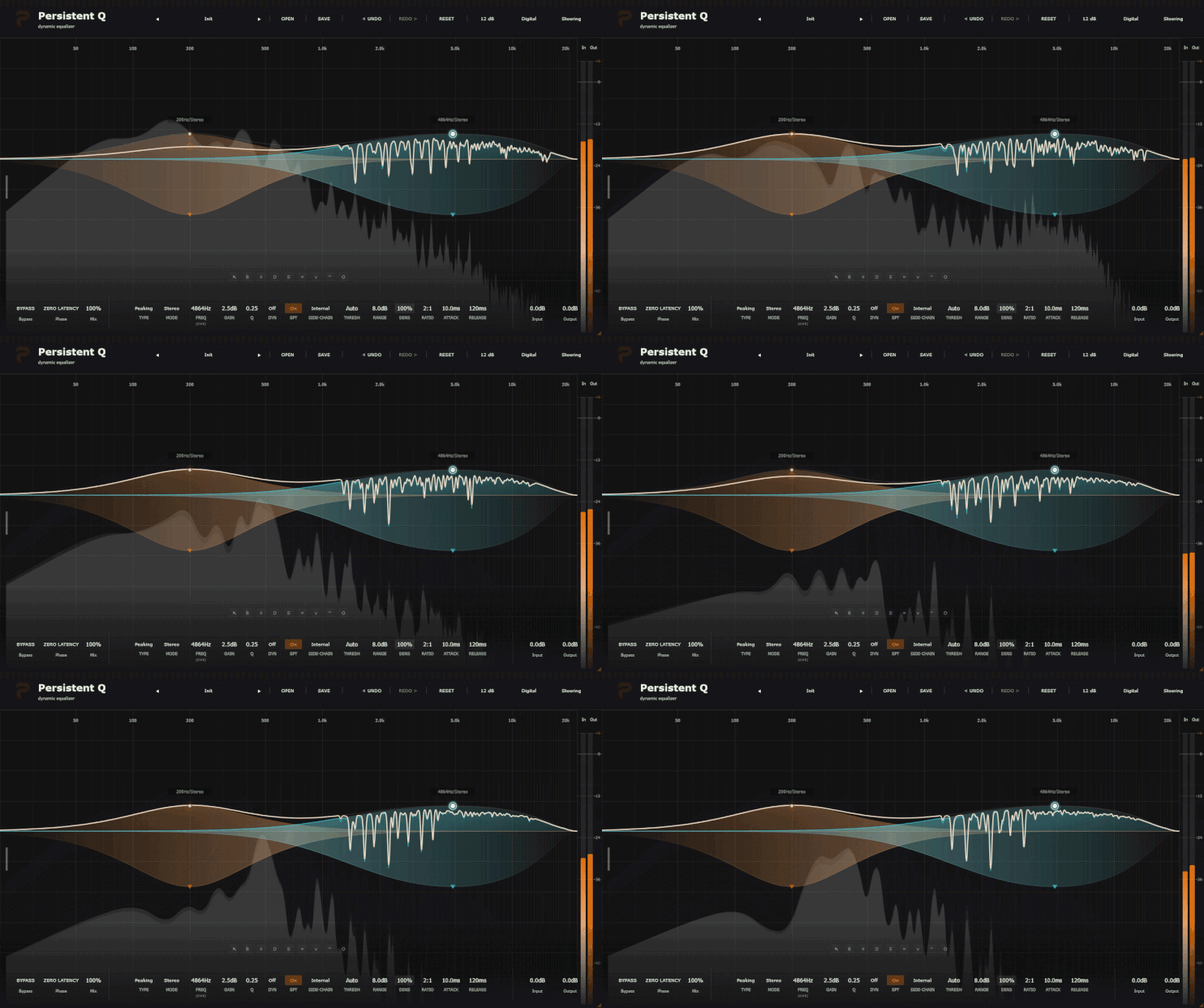
Persistent Q: Dynamic & Spectral
Traditional equalization is built on a pretty straightforward idea. Once you've set a filter, that frequency response stays locked in place no matter what the signal throws at it. A cut at 500 Hz keeps cutting, a boost at 5 kHz keeps boosting, and neither one cares whether the signal is loud, quiet, dense, or nearly silent.
That's been the foundation of EQ work for decades, and honestly, it's still the right tool for a huge range of situations. But audio signals don't sit still, and that's where things get interesting. The spectral content of a vocal shifts from syllable to syllable, an instrument's harmonic structure changes with every note it plays, and resonances often only show up under specific performance conditions. A static filter doesn't know any of that. It just keeps doing its job around the clock, processing the signal even during all those moments when no processing is actually needed.
Dynamic equalization developed as a direct answer to that limitation.
The core idea behind dynamic EQ is that it pairs frequency-selective processing with level-dependent control. Instead of holding a fixed frequency response, each band can respond to what's actually happening in the signal, kicking in only when the energy in a monitored region pushes past a defined threshold and then stepping back once things settle down.
Functionally, it's not too far off from thinking of it as a compressor that's been assigned to a specific slice of the spectrum. When the energy within that slice crosses the threshold, gain reduction kicks in according to whatever dynamic parameters you've set. When it drops back below, the band gradually returns to its neutral state.
The big win here is transparency. Because the processing only activates when it's actually needed, the overall tonal character of the source stays largely intact during the passages where nothing is happening. That means you can address a problematic frequency region without the kind of tonal compromise that tends to creep in when you're leaning hard on a static cut.
Vocal resonance control is one of the most natural applications for this. Certain vowel sounds can push a lot of energy into a narrow frequency region, giving the voice a harsh or nasal edge. A static cut will deal with the problem, but it'll also pull energy out of every moment in the performance where the issue isn't there. A dynamic band can target the resonance specifically, attenuating when it becomes excessive and leaving the natural tonal balance of everything else alone.
The same thinking applies to low-frequency management. Bass instruments, kick drums, and other low-end sources often build up in a level-dependent way that static EQ handles awkwardly. Dynamic EQ lets you respond to that buildup selectively, keeping the weight and impact of the source intact while reining in the parts that get out of hand.
Dynamic EQ is a significant step forward from traditional static processing, but it still treats each band as a single processing region, responding to everything contained within it as one collective unit.
Spectral processing takes things further.
Rather than treating a frequency band as a single block, spectral processing looks inside that region and analyzes the individual frequency components living within it. That makes it possible to make processing decisions at a much finer level of detail than anything band-based approaches can manage.
To see why that matters, imagine a frequency region that contains both desirable harmonic content and a narrow resonant peak sitting on top of it. A traditional dynamic EQ band has to respond to the whole region at once. When gain reduction kicks in, it pulls down the resonance and the surrounding musical content together, and there's no way around that.
Spectral processing can tell the difference. Individual resonant components can be identified and dealt with independently, leaving the adjacent frequency information largely untouched. The result tends to feel considerably more transparent, because the corrective work is concentrated specifically on what's causing the problem rather than the entire frequency neighborhood around it.
This becomes especially valuable when you're working with resonances that are constantly shifting. Vocals, acoustic instruments, orchestral recordings, and complex program material are all full of resonant structures that appear, disappear, and move around in frequency as the performance unfolds. Spectral processing can track those changes and respond in real time, reducing unwanted emphasis while keeping the natural character of the source intact.
It's worth drawing a clear line between what these two approaches actually do, because they're often talked about together in a way that blurs the distinction.
Dynamic EQ determines when a band should react. Spectral processing determines how selectively that reaction plays out within the affected region. Dynamic EQ is primarily concerned with level-dependent behavior across a defined frequency range. Spectral processing is concerned with the internal structure of that range and where exactly the energy is concentrated within it.
In practice, the two complement each other well. Dynamic processing can establish broader control over a problematic region, and spectral processing can then refine that response by zeroing in on localized resonances within the same area. Working together, they offer a level of precision that's genuinely difficult to reach with conventional equalization techniques on their own.
Persistent Q brings both of these approaches into a single, unified workflow. Each band can operate as a conventional parametric equalizer, a dynamic equalizer, or a dynamically controlled spectral processor depending on what the material actually calls for, all within the same interface and the same set of frequency-domain tools.
The goal here isn't to replace traditional EQ. Static filters are still the right call for broad tonal shaping, general corrective work, and overall spectral balance, and nothing about dynamic or spectral processing changes that. What these approaches do is extend EQ into territory where fixed frequency responses simply aren't the right tool for the job.
As production techniques keep evolving, frequency-domain processing increasingly needs to be able to adapt to what the signal is doing moment to moment. Dynamic equalization and spectral processing are two of the more important developments in that direction, offering greater transparency, more precise control, and a more intelligent way of working with complex audio material.
Persistent Q was built to make these techniques genuinely accessible without asking you to abandon the parametric EQ workflow you already know. By combining static, dynamic, and spectral processing in one environment, it covers a much wider range of equalization strategies without requiring a different tool for every situation.