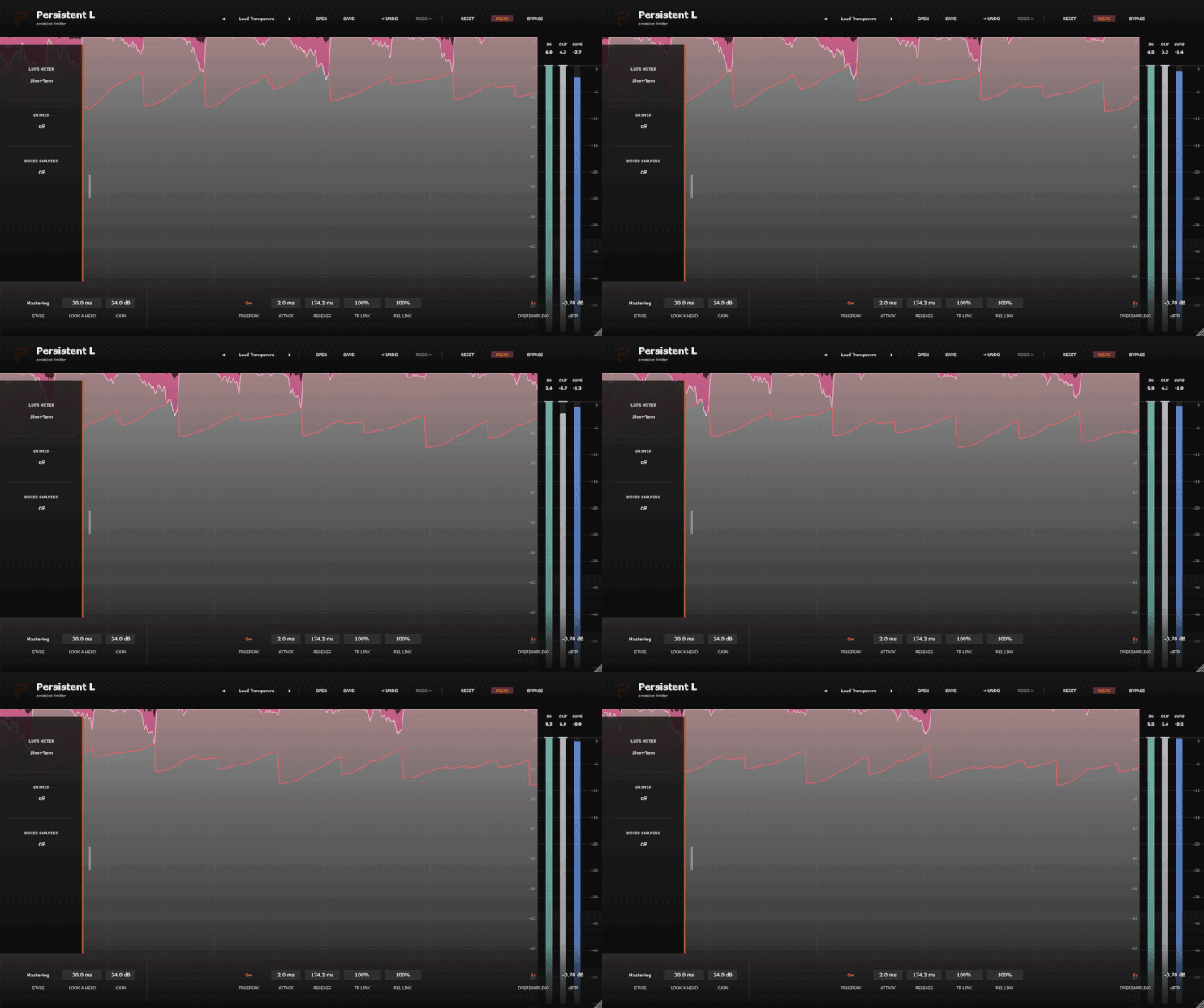
Persistent L : Oversampling, Dither, and Noise Shaping
The audible quality of a limiter is determined by more than its gain reduction algorithm.
While attack behavior, release behavior, look-ahead processing, and transient preservation all influence the character of a limiter, the final quality of a digital signal is also affected by a series of technical processes that occur beneath the surface of normal operation.
Among the most important of these processes are oversampling, dithering, and noise shaping.
These technologies are often discussed as technical considerations rather than creative tools. In practice, however, they play a significant role in determining how accurately a digital system preserves audio during processing and delivery.
Their purpose is not to change the music.
Their purpose is to prevent the digital system from changing the music unintentionally.
To understand why these processes exist, it is necessary to examine the limitations of digital audio itself.
Digital audio represents a continuous analog waveform using discrete samples captured at a fixed rate. During playback, these samples are reconstructed into a continuous waveform through interpolation and filtering.
For most practical applications, this process is remarkably accurate.
However, certain forms of signal processing can expose limitations that are not immediately visible when observing individual samples alone.
One such limitation emerges whenever nonlinear processing is applied.
Limiting is fundamentally a nonlinear operation.
When a limiter reduces gain in response to changing signal conditions, new spectral components may be introduced. These components often extend beyond the frequency range represented by the original digital signal.
If these newly generated frequencies exceed the available bandwidth of the system, they cannot be represented correctly.
Instead, they are reflected back into the audible spectrum as unwanted artifacts.
This phenomenon is known as aliasing.
Aliasing is one of the primary challenges of digital nonlinear processing.
Unlike harmonic distortion, which may be perceived as musical or desirable, aliasing introduces frequency components that are unrelated to the original harmonic structure of the signal. These artifacts often appear as harshness, brittleness, loss of clarity, or unnatural high-frequency texture.
As limiting becomes more aggressive, the risk of aliasing generally increases.
The solution is oversampling.
Oversampling temporarily increases the internal sample rate of the processing system. Before limiting occurs, the signal is converted to a higher-resolution representation. Processing is then performed within this expanded bandwidth before the signal is returned to the original sample rate.
By increasing the available frequency range during processing, oversampling provides additional space for newly generated spectral content to exist without immediately folding back into the audible spectrum.
The result is greater accuracy.
Transient behavior becomes cleaner.
High-frequency detail is preserved more effectively.
Potential aliasing artifacts are reduced.
The reconstructed output more closely resembles the intended behavior of the limiting algorithm.
The audible benefits of oversampling are often most apparent under demanding conditions.
Material containing strong transients, dense harmonic content, or aggressive limiting settings can reveal differences that may be difficult to detect at lower processing intensities.
As gain reduction increases, the precision offered by higher oversampling factors often becomes increasingly valuable.
However, oversampling is not without cost.
Higher processing rates require additional computational resources. Every increase in oversampling factor expands the amount of data that must be processed in real time. Consequently, engineers must often balance processing quality against available CPU performance.
For this reason, modern processors frequently provide multiple oversampling options.
Lower settings offer reduced computational load and faster operation.
Higher settings prioritize maximum processing accuracy.
Persistent L provides oversampling options ranging from low-latency operation to high-precision processing environments, allowing users to select the appropriate balance for the task at hand.
While oversampling addresses accuracy during processing, another challenge emerges when audio is prepared for final distribution.
This challenge involves bit depth.
Digital audio stores amplitude information using a finite number of possible values. The greater the bit depth, the more accurately signal levels can be represented. Modern production environments commonly operate at 24-bit or 32-bit floating-point precision, providing enormous dynamic range and extremely low quantization error.
However, final delivery formats do not always preserve this level of precision.
Certain distribution workflows require conversion to lower bit depths.
Whenever bit depth is reduced, information must be discarded.
This process is known as quantization.
Quantization introduces error because the original signal can no longer be represented with perfect precision. Instead, each sample must be rounded to the nearest available value.
Without proper treatment, this rounding process produces distortion.
Unlike analog noise, quantization distortion is directly related to the signal itself. Because it changes according to the content being reproduced, the resulting artifacts can be surprisingly audible under certain conditions.
Low-level material is particularly vulnerable.
Fade-outs, quiet passages, reverb tails, ambient recordings, and delicate acoustic content may reveal quantization artifacts as roughness, granularity, or unnatural breakup.
The solution is dithering.
Dither introduces a carefully controlled noise signal before bit-depth reduction occurs. Although adding noise may initially appear counterintuitive, the process serves a highly specific purpose.
The added noise randomizes quantization error.
Instead of producing signal-dependent distortion, the quantization process produces a low-level noise floor that is considerably less objectionable to human hearing.
The result is greater transparency.
Fine details remain more natural.
Low-level information survives bit-depth conversion more gracefully.
Fade-outs remain smooth.
Reverb decays retain continuity.
Subtle spatial information remains intact.
An important characteristic of dithering is that it does not eliminate quantization error.
Rather, it changes the way that error is perceived.
Distortion is transformed into noise.
Because the human auditory system generally tolerates low-level noise more effectively than signal-correlated distortion, the perceived quality of the final result improves significantly.
The effectiveness of dithering can be enhanced further through noise shaping.
While dithering controls the nature of quantization error, noise shaping controls its spectral distribution.
Human hearing is not equally sensitive across the entire frequency spectrum. Certain frequency regions are perceived more readily than others. Noise shaping exploits this characteristic by redistributing a portion of the dither energy toward regions where it is less perceptible.
The total amount of noise remains similar.
Its placement changes.
By moving a greater proportion of the noise energy away from the most sensitive regions of human hearing, the perceived noise floor can be reduced without compromising the benefits of dithering itself.
Different noise shaping curves produce different perceptual results.
Some prioritize transparency within the midrange.
Others maximize apparent dynamic range.
Certain curves are optimized for specific delivery formats or listening environments.
The optimal choice depends upon both the material and the intended destination.
Although dithering and noise shaping operate at extremely low signal levels, their influence on final delivery should not be underestimated.
Mastering engineers often spend considerable effort preserving details that exist only a few decibels above the noise floor. The final moments of a reverb tail, the ambience of a recording space, or the subtle decay of an acoustic instrument may all reside within this region.
Proper finalization ensures that these details survive the transition from production environment to delivery format.
Persistent L integrates oversampling, dithering, and noise shaping into a unified mastering workflow because these processes ultimately serve a common purpose.
Oversampling protects accuracy during processing.
Dithering protects accuracy during quantization.
Noise shaping optimizes how unavoidable errors are perceived by the listener.
Together, they form the final stage of digital signal refinement.
Limiting is often viewed as the last processor in a mastering chain.
From a technical perspective, however, the process extends beyond gain reduction alone. The quality of the final master depends not only on how peaks are controlled, but also on how accurately the signal is represented, processed, and delivered.
Persistent L approaches these responsibilities as an integrated system. Peak management, loudness control, oversampling accuracy, quantization transparency, and final delivery preparation are treated as interconnected aspects of a single objective: preserving the integrity of the music from the mastering session to the listener's playback device.