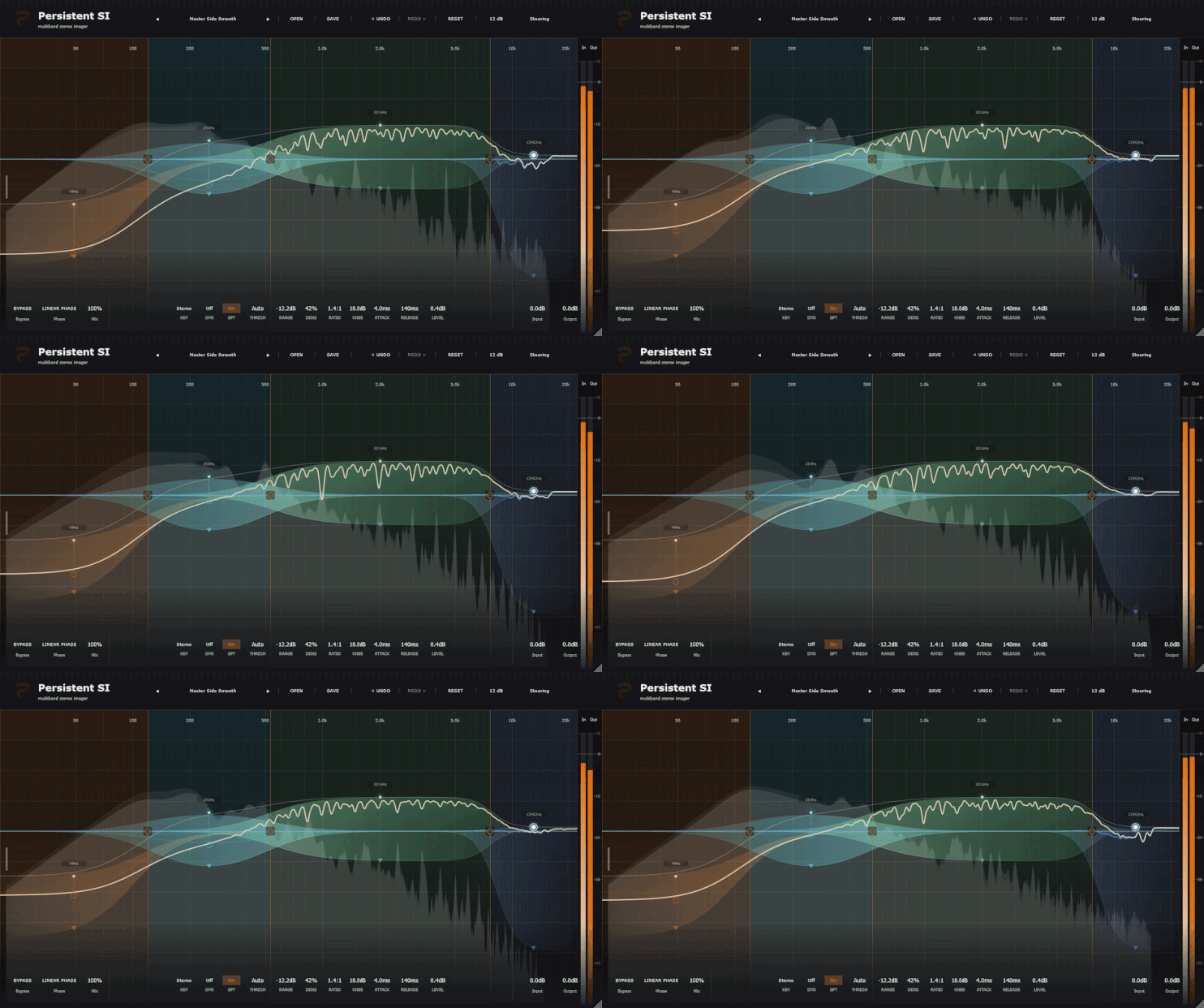
Persistent SI : Multiband Imaging
The concept of stereo width is often discussed as though it were a single property of a mix.
Engineers commonly describe a production as narrow, wide, focused, expansive, or immersive, implying that spatial perception can be represented by a single dimension. In practice, however, stereo width is not a uniform characteristic distributed equally across the frequency spectrum.
Different frequency regions contribute to spatial perception in fundamentally different ways.
For this reason, the concept of a single global stereo image is, to some extent, an oversimplification.
A mix does not possess one stereo field.
It possesses many.
Low frequencies occupy one form of spatial role.
Midrange information occupies another.
High frequencies contribute yet another layer of spatial perception.
Together, these regions combine to create the overall impression of width, depth, focus, and dimensionality.
Understanding this distinction is essential to understanding multiband imaging.
Human spatial perception is frequency dependent.
The auditory system relies on multiple mechanisms to determine the apparent location and size of a sound source. Some of these mechanisms are more effective at high frequencies, while others operate more effectively within lower regions of the spectrum.
At low frequencies, wavelength becomes extremely large relative to the dimensions of the human head.
As a result, directional information becomes less precise. The listener is generally less sensitive to the exact spatial location of low-frequency energy than to higher-frequency content.
For this reason, excessive stereo width in the bass region often provides little perceptual benefit while introducing potential technical problems.
Wide low frequencies may reduce mono compatibility, weaken center stability, and create inconsistent playback behavior across different listening environments.
Consequently, many successful mixes maintain a relatively focused low-frequency foundation.
The objective is not width.
The objective is stability.
The midrange occupies a different role.
This region contains much of the information responsible for musical identity. Vocals, guitars, keyboards, orchestral elements, and countless other sources derive much of their recognizability from the midrange spectrum.
Spatial decisions within this region directly influence intelligibility, separation, and focus.
A mix with an unstable midrange image may feel unfocused regardless of how wide its overall stereo field appears.
At the same time, excessive centralization may reduce openness and depth.
The midrange therefore often requires careful balance between stability and expansion.
High frequencies introduce yet another set of perceptual characteristics.
The auditory system relies heavily on upper-frequency information when determining spatial position and environmental context. Reflections, ambience, air, and localization cues frequently exist within the upper portions of the spectrum.
Controlled expansion within these regions can significantly increase the perception of width and dimensionality without compromising the structural integrity of the mix.
These observations reveal an important limitation of traditional stereo imaging processors.
A single width control affects every frequency equally.
The same spatial adjustment applied to the sub-bass region is simultaneously applied to the vocal range, the upper harmonics, and the ambient content of the mix.
This assumes that every part of the spectrum shares the same spatial objective.
In reality, this is rarely the case.
A bass foundation may require focus.
The midrange may require balance.
The upper spectrum may require expansion.
Treating all frequency regions identically often forces compromise.
Increasing width to enhance openness may destabilize the low end.
Reducing width to preserve low-frequency stability may limit the dimensionality of the upper spectrum.
Multiband imaging addresses this problem by separating the stereo field into independent frequency regions.
Rather than treating the spectrum as a single spatial entity, the signal is divided into multiple bands, each capable of occupying its own role within the overall stereo image.
This transforms stereo imaging from a global process into a form of frequency-dependent spatial design.
Each band becomes an independent spatial environment.
Width can be increased where expansion is beneficial.
Focus can be preserved where stability is required.
Spatial balance can be optimized according to the perceptual function of each region.
The result is not merely a wider mix.
The result is a more organized one.
Within Persistent SI, this philosophy forms the foundation of the processing architecture.
The spectrum is divided into multiple bands through adjustable crossover regions, allowing each portion of the frequency range to be analyzed and controlled independently. Rather than assuming a fixed relationship between frequency and width, the system allows the engineer to determine how each region contributes to the overall spatial structure of the mix.
This flexibility becomes particularly important because different productions often require different spatial strategies.
Electronic music may benefit from tightly controlled low frequencies combined with expansive upper content.
Orchestral material may require a broader and more continuous distribution of spatial energy.
Acoustic productions may emphasize natural balance and localization.
A fixed stereo architecture cannot accommodate every scenario equally.
Multiband processing allows the spatial structure to be tailored to the musical objective.
An important component of this workflow is the concept of spatial identity.
Within Persistent SI, each band can assume a different functional role through its assigned key behavior. Some regions may prioritize Mid information and reinforce central focus. Others may emphasize Side content and contribute additional width. Certain regions may preserve a more balanced Stereo relationship.
This allows the spectrum to be organized according to purpose rather than treated as a uniform stereo field.
The practical implications extend beyond simple widening and narrowing.
A low-frequency band can provide stability and translation.
A midrange band can maintain clarity and presence.
An upper band can introduce openness and dimensionality.
Together, these regions form a coherent spatial hierarchy that supports both technical reliability and musical expression.
This concept represents a shift in perspective.
Traditional stereo imaging asks a simple question:
How wide should the mix be?
Multiband imaging asks a different question:
Which parts of the mix should be wide?
The distinction may appear subtle, but it fundamentally changes the way spatial processing is approached.
Persistent SI is built upon this principle. By allowing individual frequency regions to occupy distinct spatial roles, stereo imaging becomes more than a width adjustment process. It becomes a method of organizing spatial energy throughout the spectrum, allowing width, focus, balance, and dimensionality to coexist within a single coherent stereo field.
Once the spectrum has been divided into independent spatial regions, additional opportunities emerge. The behavior of those regions can respond dynamically to changing signal conditions, and their spatial characteristics can be refined beyond simple level relationships. These concepts form the basis of the Dynamic and Spectral processing systems explored in the following chapter.