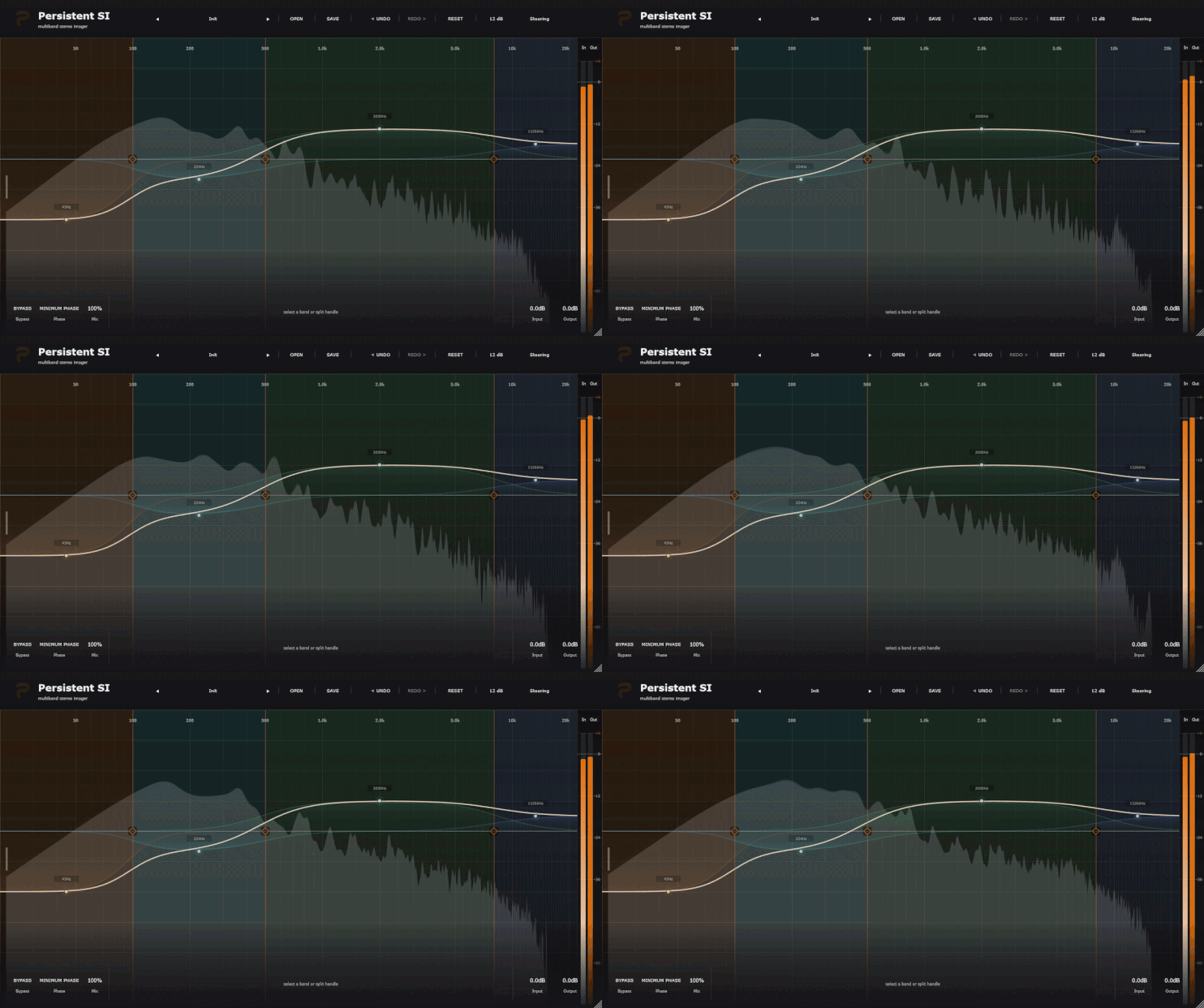
 Persistent SI : Introduction
Spatial perception is one of the most important aspects of modern audio production.
When listeners describe a mix as wide, immersive, open, intimate, focused, or spacious, they are often responding not to frequency balance or dynamic range alone, but to the way sound occupies space between the loudspeakers. The apparent position, width, depth, and movement of individual elements contribute significantly to how music is experienced.
For this reason, stereo imaging has become a fundamental component of both mixing and mastering.
A well-balanced stereo image allows musical elements to coexist without excessive masking, improves separation between instruments, and enhances the listener's sense of dimension. Conversely, poor spatial organization can cause a mix to feel crowded, unstable, unfocused, or artificially exaggerated.
Understanding stereo imaging begins with understanding how spatial information is represented within a stereo signal.
A conventional stereo recording consists of two channels: left and right. While this format appears straightforward, the spatial information contained within those channels is considerably more complex. The listener does not perceive two independent signals. Instead, the auditory system continuously interprets differences between the channels to construct a three-dimensional impression of space.
Small differences in level influence perceived position.
Differences in timing affect localization.
Variations in spectral content contribute to the perception of width, distance, and environment.
Together, these relationships form the basis of stereo imaging.
One of the most useful frameworks for understanding stereo information is the Mid/Side model.
Within this model, the stereo signal can be separated into two complementary components.
The Mid component represents information shared between the left and right channels. Sounds positioned near the center of the stereo field typically contribute strongly to this region. Lead vocals, bass instruments, kick drums, snares, and other foundational elements often occupy a substantial portion of the Mid signal.
The Side component represents information that differs between the channels. Ambient information, stereo effects, room reflections, spatial textures, and wide instrumental elements frequently contribute more strongly to this region.
Together, Mid and Side form the structural foundation of stereo perception.
The relationship between them determines how wide, focused, stable, or expansive a mix appears.
For many years, stereo imaging processors have approached this relationship in a relatively simple manner.
The user increases or decreases stereo width.
The Side signal becomes louder or quieter.
The image appears wider or narrower.
While effective in some situations, this approach often oversimplifies a fundamentally complex problem.
Not all frequencies contribute equally to spatial perception.
Low frequencies behave differently from high frequencies.
The human auditory system localizes low-frequency information with significantly less precision than higher-frequency content. Excessive stereo width in the low-frequency region can reduce stability, weaken mono compatibility, and create unpredictable playback behavior across different listening systems.
Midrange frequencies present a different challenge.
This region contains much of the musical information responsible for intelligibility, tonal identity, and emotional communication. Excessive spatial manipulation within the midrange can alter the perceived focus of a mix and reduce the clarity of important elements.
High frequencies contribute yet another set of characteristics.
Because the human auditory system relies heavily on high-frequency information for localization and spatial awareness, controlled expansion within the upper spectrum can significantly increase the perception of openness and dimension.
These differences reveal an important limitation of traditional stereo imaging.
A single width control assumes that the entire frequency spectrum should be treated identically.
In reality, different regions of the spectrum often require different spatial objectives.
Low frequencies may benefit from greater central stability.
Midrange frequencies may require careful balance between focus and width.
High frequencies may benefit from additional expansion and openness.
Effective stereo imaging therefore requires more than global width adjustment.
It requires frequency-dependent spatial control.
This principle forms the foundation of multiband imaging.
By dividing the spectrum into independent frequency regions, spatial characteristics can be shaped according to the perceptual role of each band. Width, focus, energy distribution, and spatial balance can be optimized separately throughout the spectrum rather than applied uniformly across the entire signal.
The benefits extend beyond simple widening.
A multiband approach allows engineers to reinforce low-frequency stability, improve midrange organization, enhance high-frequency openness, and maintain greater control over overall stereo balance. Spatial design becomes a deliberate process rather than a single global adjustment.
Persistent SI was developed around this philosophy.
Rather than treating stereo width as a static parameter, Persistent SI approaches imaging as a dynamic relationship between frequency, energy, and spatial perception. The processor analyzes how Mid and Side information interact across multiple frequency regions and provides independent control over the spatial role of each band.
This allows stereo imaging to function as a form of spectral space management.
The objective is not merely to make a mix wider.
The objective is to determine where width should exist, where focus should be preserved, and how those relationships should evolve throughout the frequency spectrum.
This perspective becomes increasingly important in modern production environments where mixes must translate consistently across headphones, nearfield monitors, large playback systems, mobile devices, and immersive listening environments. A stereo image that appears impressive in one context may become unstable or exaggerated in another.
Effective imaging therefore requires balance as much as expansion.
A successful stereo field is not defined by maximum width.
It is defined by the appropriate distribution of spatial energy.
Persistent SI provides the tools necessary to shape that distribution with precision. Through multiband processing, dynamic spatial control, spectral analysis, and adaptive steering systems, stereo imaging becomes more than a widening process. It becomes an intentional method of organizing space within a mix.
Understanding this relationship between frequency and spatial perception provides the foundation for the chapters that follow. The next section examines the core architecture of Persistent SI: the multiband imaging system that allows individual frequency regions to occupy distinct and independent spatial roles within the stereo field.