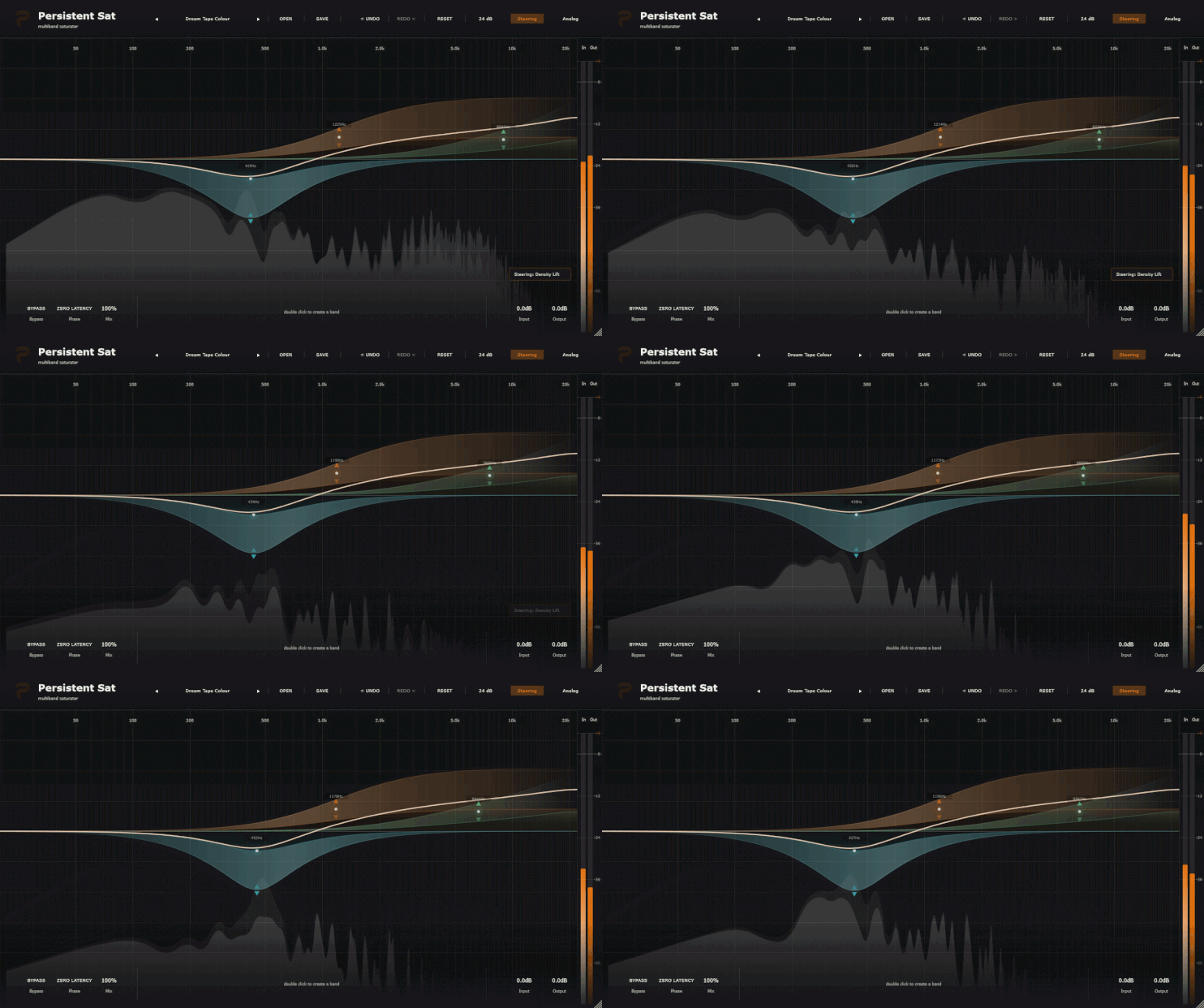
Persistent Saturator : Auto Steering
Harmonic generation is inherently dependent upon the signal that produces it.
Unlike linear processing systems, which operate according to fixed mathematical relationships, saturation is fundamentally influenced by the structure of the incoming audio. The amount of harmonic content generated, the spectral distribution of that content, and the perceived character of the resulting sound are all affected by the behavior of the source itself.
This relationship is one of the reasons saturation is often described as musical.
The process does not simply modify a signal.
It reacts to it.
As performance intensity changes, harmonic generation changes. As spectral balance shifts, the behavior of the nonlinear system shifts as well. A saturation process applied to a vocal phrase may respond differently to a sustained vowel than to a sharp consonant. A bass guitar may generate a different harmonic structure for each note despite identical processing settings. A synthesizer patch may exhibit entirely different nonlinear behavior as its harmonic content evolves throughout a performance.
In practice, however, most saturation systems remain static.
The engineer selects a drive amount, chooses a processing mode, and defines a frequency distribution. Once these parameters have been established, the processor continues to operate according to the same configuration regardless of changes occurring within the source material.
This approach is effective and predictable.
However, it assumes that the optimal saturation behavior remains constant throughout the entire performance.
Music rarely behaves this way.
The spectral structure of a signal is continuously evolving.
Fundamental frequencies move.
Harmonic relationships change.
Transient energy appears and disappears.
Resonances emerge and fade.
The frequency regions that contribute most strongly to the musical identity of a source are often different from one moment to the next.
Consequently, a saturation band configured to target a particular spectral feature may become less relevant as that feature moves throughout the frequency spectrum.
A drive setting that produces the desired harmonic density during one passage may become excessive or insufficient during another.
The challenge is not that the saturation is incorrect.
The challenge is that the musical target is no longer stationary.
Persistent Saturator addresses this problem through Auto Steering.
Auto Steering extends the adaptive processing philosophy introduced throughout the Persistent Series and applies it to harmonic generation. Rather than treating saturation bands as permanently fixed structures, Auto Steering allows the processor to analyze the incoming signal and adapt its behavior in response to meaningful spectral movement.
The objective is not automation.
The objective is continuity.
When an engineer applies saturation to a specific frequency region, the decision is usually based upon an identifiable musical feature. A vocal presence region, a bass harmonic structure, a guitar resonance, or a transient-rich frequency area may all serve as targets for harmonic enhancement.
If the feature moves, the intended relationship between the saturation process and the source may gradually weaken.
Auto Steering helps preserve that relationship.
As important spectral structures evolve, the associated saturation bands can adapt accordingly. Harmonic generation remains connected to the musical content that originally motivated the processing decision.
This behavior becomes particularly valuable when working with pitched material.
Most musical instruments do not occupy a single frequency location. The fundamental frequency changes with each note, and the harmonic structure surrounding that fundamental changes as well. A saturation band positioned to enhance one note may interact differently with another note occurring only moments later.
Traditional processing requires the engineer to accept this variation.
Auto Steering allows the processor to respond dynamically.
Rather than remaining attached to a fixed coordinate within the frequency spectrum, the saturation system can remain focused on the relevant musical structure itself.
The result is a more consistent harmonic relationship across a wider range of material.
Importantly, Auto Steering is not limited to frequency tracking alone.
Within Persistent Saturator, steering behavior may also influence the intensity of harmonic generation.
In conventional saturation systems, drive amount is generally static. A band configured for a particular drive level continues to generate the same degree of nonlinear activity regardless of the spectral importance of the material passing through it.
Auto Steering introduces a more adaptive approach.
Depending on the selected Steering Style, the processor can increase or decrease harmonic activity relative to the user-defined Drive setting. The original Drive value remains the reference point, but the actual harmonic response can adapt according to the characteristics of the incoming signal.
This allows harmonic enhancement to behave less like a fixed effect and more like a responsive musical process.
Strong spectral features may receive additional emphasis.
Less significant structures may receive reduced harmonic treatment.
The result is a more organic distribution of nonlinear activity throughout the signal.
This concept is particularly important because harmonic generation influences perception far beyond simple distortion.
Additional harmonics affect clarity, density, loudness perception, transient impact, tonal weight, and apparent proximity within a mix. Excessive harmonic content can overwhelm a source, while insufficient harmonic content may leave it lacking energy or presence.
The optimal balance is rarely constant.
Auto Steering allows harmonic density to evolve alongside the source itself, helping maintain musical consistency without requiring continuous manual adjustment.
Different Steering Styles provide different interpretations of this adaptive behavior.
Some styles prioritize precision and responsiveness, closely following rapid spectral movement and producing highly active harmonic adaptation.
Others emphasize stability and restraint, creating smoother responses better suited to sustained material, mastering applications, or subtle tonal enhancement.
The choice of Steering Style therefore influences not only how the processor moves, but how it interprets the musical significance of the incoming signal.
This distinction reflects an important design philosophy.
Auto Steering is not intended to replace the engineer.
The system does not make creative decisions independently, nor does it override the user's tonal objectives. Frequency placement, DriveType selection, and Drive intensity remain under direct user control.
Instead, Auto Steering functions as an intelligent extension of those decisions.
The user defines the destination.
Steering assists in maintaining the path.
Within Persistent Saturator, harmonic generation is no longer treated as a completely static process. Frequency regions can adapt to evolving musical structures, and harmonic intensity can respond to changing signal conditions. The processor remains guided by the engineer's intent while becoming more aware of the material it is processing.
This transforms saturation from a fixed layer of coloration into a responsive harmonic system.
EQ Style Distortion determines where harmonic activity exists.
DriveType determines the character of that activity.
Auto Steering determines how that activity evolves with the music itself.
Together, these systems form the foundation of Persistent Saturator's approach to frequency-selective harmonic design, allowing saturation to function not merely as distortion, but as an adaptive and musically aware component of modern audio production.