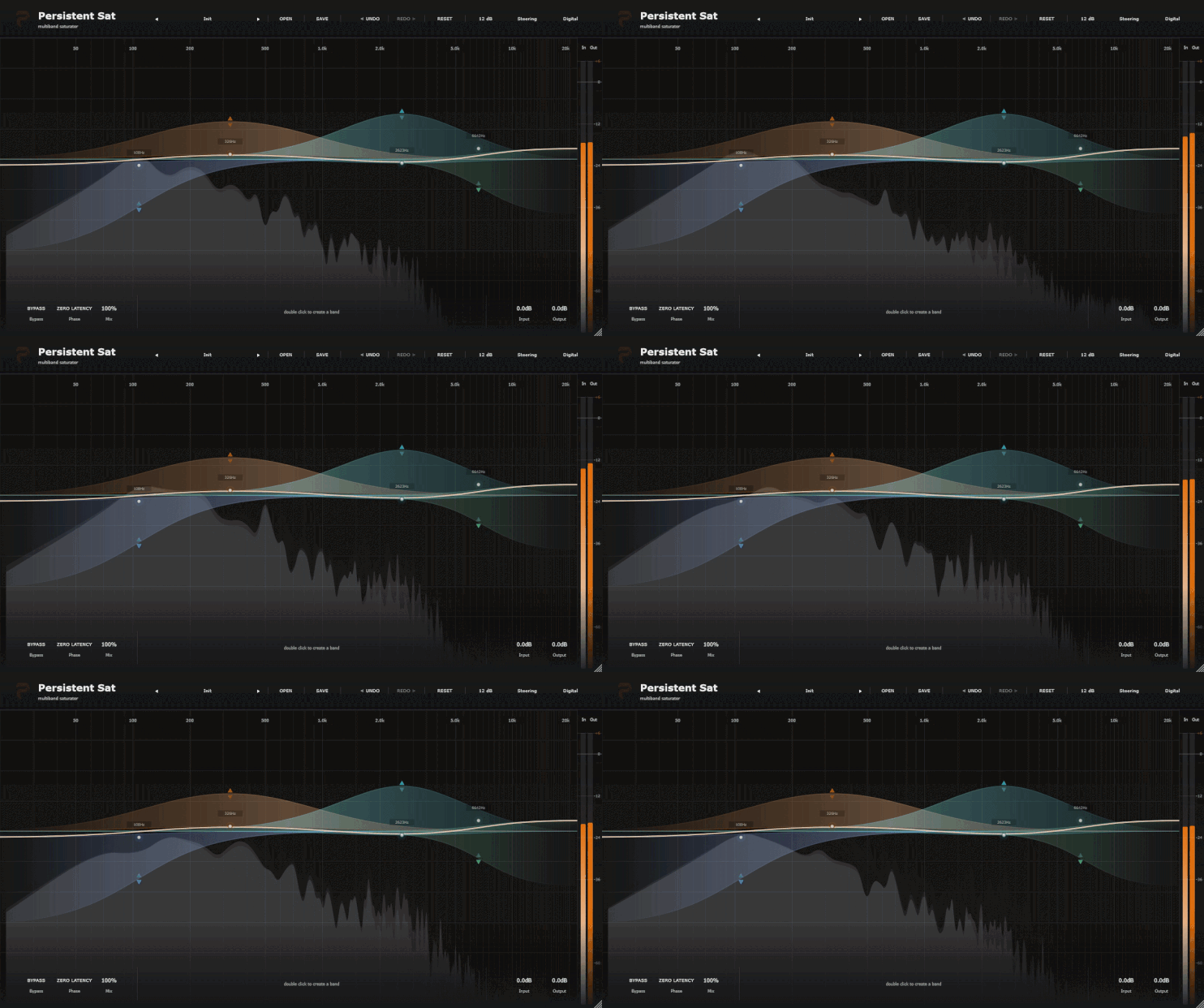
 Persistent Saturator : DriveType
Once the location of harmonic generation has been defined, the next question becomes equally important.
What kind of harmonics should be generated?
Not all saturation behaves in the same manner. Two processors may receive the same signal, operate at the same drive level, and produce dramatically different sonic results. The difference lies not in the amount of distortion, but in the structure of the nonlinear process itself.
Every saturation system possesses a unique transfer characteristic.
As an audio signal passes through a nonlinear stage, the relationship between input level and output level becomes increasingly complex. Some systems introduce smooth and gradual compression of peaks. Others generate abrupt nonlinear transitions. Some emphasize lower-order harmonics, while others produce richer upper-harmonic content. Certain processes preserve the musical relationship of the original signal, while others intentionally introduce instability, degradation, or spectral destruction.
The audible result is commonly described as character.
Character is often discussed using subjective terms such as warmth, punch, aggression, density, thickness, brightness, or texture. While these descriptions are useful from a musical perspective, they are ultimately manifestations of underlying harmonic behavior.
Different nonlinear systems create different harmonic architectures.
For this reason, saturation should not be viewed as a single process.
It is more accurate to think of saturation as a family of nonlinear behaviors, each possessing its own tonal identity and dynamic response.
Within Persistent Saturator, these behaviors are represented through DriveTypes.
A DriveType defines the manner in which harmonic content is generated, distributed, and perceived. While EQ Style Distortion determines where harmonic generation occurs, DriveType determines the character of the harmonics themselves.
Together, these systems form the foundation of frequency-selective saturation.
The significance of DriveType becomes particularly apparent when comparing different forms of analog coloration.
Vacuum tube circuits have long been associated with musical saturation. As signal levels increase, tubes often introduce nonlinear behavior gradually rather than abruptly. Harmonic generation tends to emerge smoothly, producing a sense of warmth, density, and forward presence without immediately sounding distorted.
Many engineers value this behavior because it enhances musical material while preserving its natural character.
Magnetic tape exhibits a different response.
Rather than emphasizing harmonic coloration alone, tape saturation often combines harmonic generation with subtle dynamic compression. Peaks become progressively controlled as signal levels increase, producing a perception of cohesion and smoothness. Harmonics emerge alongside gentle transient shaping, creating a character frequently associated with analog recordings.
Transformer-based circuits introduce another type of coloration.
The interaction between magnetic materials, impedance relationships, and signal level can produce harmonic structures that feel solid, weighty, and dimensional. Rather than sounding overtly distorted, transformer saturation often contributes a sense of depth and physicality to the signal.
Amplifier-style saturation introduces yet another behavior.
In these systems, nonlinear processes frequently become more pronounced as drive levels increase. Harmonic density rises, transients become more aggressive, and the overall character may shift from subtle enhancement toward obvious coloration. Such behaviors are often desirable when greater presence, impact, or tonal attitude is required.
These examples illustrate an important principle.
The audible identity of saturation is determined not only by how much harmonic content is generated, but by the way in which that content is created.
A small amount of aggressive distortion may sound more obvious than a large amount of smooth saturation.
Conversely, substantial harmonic enhancement may remain surprisingly transparent if the underlying nonlinear behavior is sufficiently gentle.
Persistent Saturator provides multiple DriveTypes precisely because different musical objectives require different nonlinear architectures.
Tube-based DriveTypes focus on smooth harmonic enhancement and musical coloration.
Tape-inspired DriveTypes emphasize density, cohesion, and controlled energy.
Amp-style DriveTypes introduce greater harmonic intensity and forward character.
Transformer-oriented DriveTypes contribute solidity, weight, and dimensional complexity.
Traditional Saturator modes provide flexible harmonic enhancement suitable for a broad range of applications.
Each category represents a different approach to harmonic generation rather than merely a different amount of distortion.
This distinction becomes particularly important when multiple saturation bands are used simultaneously.
Because each frequency region can operate as an independent harmonic zone, different portions of the spectrum may benefit from different nonlinear behaviors.
Low frequencies often require stability and controlled harmonic reinforcement.
Midrange frequencies may benefit from additional density and presence.
Upper frequencies may require subtle enhancement, brightness, or texture without becoming harsh.
By assigning different DriveTypes to different regions, the engineer gains access to a significantly broader palette of tonal possibilities than would be available through a single global saturation process.
The spectrum becomes a collection of independently voiced harmonic environments.
This capability extends beyond traditional analog emulation.
Modern digital signal processing makes it possible to explore nonlinear behaviors that have no direct hardware equivalent.
For this reason, Persistent Saturator also includes DriveTypes designed specifically for creative and experimental applications.
Unlike conventional saturation modes, these processes intentionally move beyond harmonic enhancement into the domain of spectral transformation.
Degradation algorithms may introduce instability and resolution loss.
Decimation processes alter the temporal and spectral integrity of the signal.
Bit reduction creates quantization artifacts and digital texture.
Foldback processing generates complex harmonic structures through waveform reflection and nonlinear folding.
These techniques produce results that are fundamentally different from traditional analog coloration.
Rather than enhancing the original signal, they may partially reconstruct it into something entirely new.
While such processes are often associated with sound design, they can also be employed subtly to introduce texture, movement, and uniqueness within conventional productions.
Importantly, Persistent Saturator treats all DriveTypes as components of the same harmonic design framework.
Whether the objective is transparent enhancement, analog coloration, dynamic density, aggressive distortion, or experimental transformation, the underlying workflow remains consistent.
The engineer first determines where harmonic generation should occur.
The DriveType then determines how that harmonic generation behaves.
This separation between spectral placement and harmonic character forms one of the defining principles of the system.
Traditional saturation workflows frequently combine location and character into a single process applied to the entire signal. Persistent Saturator separates these decisions, allowing each to be controlled independently.
The result is a more flexible and intentional approach to nonlinear processing.
Harmonic content becomes something that can be designed rather than merely applied.
Frequency regions can be assigned distinct identities. Different parts of the spectrum can contribute different forms of coloration. Saturation becomes less about adding distortion and more about constructing a deliberate harmonic structure across the entire signal.
In this context, DriveType serves as the tonal vocabulary of Persistent Saturator.
EQ Style Distortion defines where harmonic activity exists.
DriveType defines the language through which that activity is expressed.