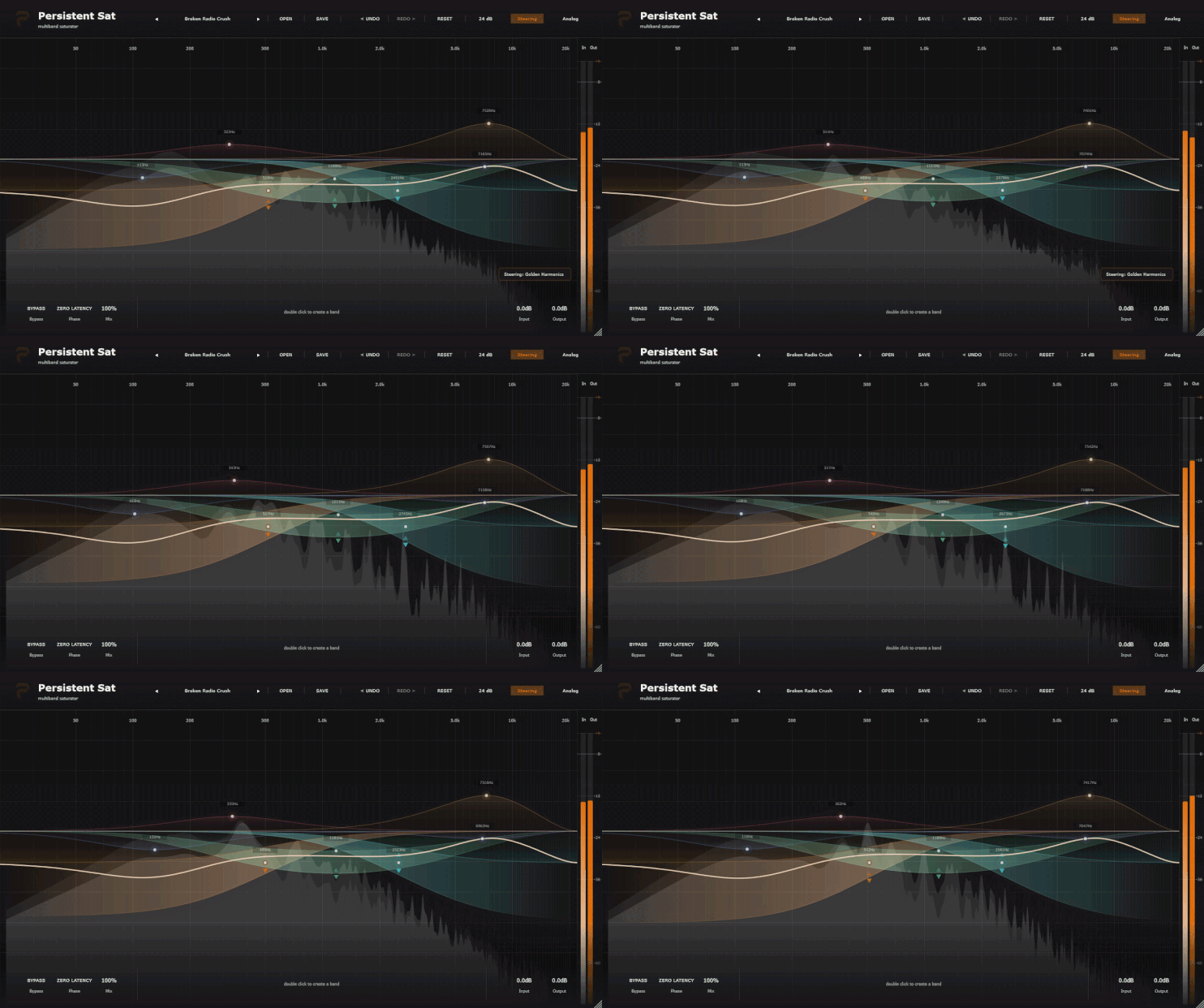
 Persistent Saturator : EQ Style Distortion
Traditional saturation processors are typically designed around a simple principle.
A signal enters the processor, a nonlinear transfer function is applied, and harmonic content is generated across the entire frequency spectrum. The engineer adjusts the amount of drive, selects a processing character, and the resulting coloration affects the signal as a whole.
This approach has been used successfully for decades.
Tape machines, tube circuits, transformers, consoles, amplifiers, and countless digital saturation processors operate according to this philosophy. The resulting sound may become warmer, denser, brighter, more aggressive, or more energetic depending on the characteristics of the nonlinear process.
Despite its effectiveness, global saturation introduces an inherent limitation.
Audio signals are rarely uniform across the frequency spectrum.
Different frequency regions contribute different perceptual functions within a mix. Low frequencies provide weight and foundation. Midrange frequencies contribute presence, intelligibility, and tonal identity. High frequencies influence clarity, air, articulation, and perceived detail.
In many situations, only a specific portion of the spectrum requires additional harmonic enhancement.
A vocal may need greater density within the presence region without affecting the low end.
A bass instrument may benefit from additional harmonic structure in the upper bass range while preserving the integrity of the sub frequencies.
A mix bus may require subtle enhancement in a narrow frequency region without introducing unnecessary coloration elsewhere.
When saturation is applied globally, every portion of the signal receives the same nonlinear treatment regardless of whether that treatment is beneficial.
The engineer is often forced to compromise.
Increasing drive to enhance one region may simultaneously alter another region that was already functioning correctly.
Persistent Saturator approaches harmonic generation from a different perspective.
Instead of treating saturation as a process that affects the entire signal equally, the system allows harmonic generation to be distributed throughout the spectrum according to a frequency-dependent structure.
This concept forms the foundation of EQ Style Distortion.
To understand this approach, it is useful to consider the role of equalization.
An equalizer allows the engineer to decide where spectral energy should be increased or reduced. Individual frequency regions can be shaped independently through filters, shelves, and bell curves, allowing precise control over tonal balance.
Persistent Saturator applies a similar philosophy to nonlinear processing.
Rather than determining where level changes occur, the user determines where harmonic generation occurs.
The processing bands function as harmonic design regions.
Each band defines a frequency area in which saturation behavior can be emphasized, reduced, or shaped according to a specific objective. The resulting workflow resembles equalization, but the outcome is fundamentally different.
The objective is not frequency balance.
The objective is harmonic architecture.
Peaking Bands provide localized control over harmonic generation.
By defining a center frequency and bandwidth, harmonic enhancement can be concentrated within a targeted spectral region. Narrow bandwidths allow highly focused coloration, while broader bandwidths can influence larger portions of the spectrum.
Shelf Bands provide a complementary approach.
Instead of targeting a specific frequency region, shelving structures allow harmonic emphasis to increase or decrease progressively across an entire side of the spectrum. Low shelves can influence bass and low-mid harmonic content, while high shelves can shape the upper spectrum and perceived brightness.
Together, these structures allow saturation to be distributed throughout the frequency spectrum with a level of precision traditionally associated with equalization.
Importantly, the visible curve does not represent a conventional EQ response.
No direct boost or attenuation is being applied to the signal simply because a band exists.
Instead, the curve represents the distribution of nonlinear activity.
Regions receiving greater drive generate additional harmonic content. Regions receiving less drive remain comparatively unaffected. The resulting spectral changes emerge from harmonic generation rather than static amplitude adjustment.
This distinction is fundamental.
An equalizer modifies frequencies that already exist.
A saturator creates frequencies that did not previously exist.
Although the visual workflow may resemble equalization, the underlying process is entirely different.
The engineer is not adjusting level.
The engineer is determining where new spectral information will be introduced.
This approach enables a degree of harmonic precision that is difficult to achieve through conventional saturation techniques.
For example, a broad midrange band may be used to increase the density and presence of a vocal without introducing excessive brightness. A low-frequency band may reinforce the harmonic structure of a bass instrument, improving translation on smaller playback systems. A high-frequency shelf may add air and excitement through harmonic enhancement rather than traditional equalization.
The resulting changes often feel more natural because they are created through the generation of new harmonic content rather than simple gain manipulation.
Another advantage emerges from the interaction between multiple bands.
Traditional saturation processors generally operate according to a single nonlinear response affecting the entire signal. Within Persistent Saturator, different regions of the spectrum can contain different harmonic objectives simultaneously.
One region may be configured for subtle enhancement.
Another may introduce substantial harmonic density.
A third may remain entirely untouched.
The spectrum effectively becomes a collection of independent harmonic zones rather than a single processing destination.
This transforms saturation from a broad coloration process into a form of spectral sculpting.
The engineer can decide not only how much saturation is applied, but where it exists, how it is distributed, and how it contributes to the overall structure of the sound.
The result is a workflow that combines the precision of modern equalization with the musical character of nonlinear processing.
Rather than applying distortion indiscriminately across an entire signal, EQ Style Distortion allows harmonic content to be designed with intentionality and precision. Frequency regions become creative destinations for harmonic enhancement, enabling saturation to function as a controlled spectral process rather than a purely global effect.
This philosophy forms the core of Persistent Saturator and establishes the foundation upon which the DriveType and Auto Steering systems operate. Once harmonic generation can be distributed throughout the spectrum, the character and behavior of that generation become equally important aspects of sound design.