 Persistent Saturator : Introduction
Saturation is one of the oldest and most widely used forms of audio processing.
Long before digital signal processing became commonplace, audio signals routinely passed through electronic circuits, magnetic tape machines, transformers, amplifiers, consoles, and other analog devices. These systems were rarely perfectly linear. As signal levels increased, subtle nonlinear behavior emerged, altering the relationship between the input and output signal.
Although these nonlinearities were originally considered technical limitations, engineers and musicians eventually discovered that many of them produced sonically desirable results.
The sound became fuller.
Transient material often felt smoother.
Sources appeared denser, more present, and more energetic.
Rather than perceiving these changes as distortion in the negative sense, listeners frequently interpreted them as warmth, depth, character, or musicality.
The foundation of saturation lies in nonlinear processing.
A linear system reproduces an input signal without generating new frequency components. Equalizers, delays, filters, and gain controls are generally designed to operate according to this principle. While they may alter level, phase, or frequency balance, they do not fundamentally change the harmonic structure of the source.
Nonlinear systems behave differently.
When a nonlinear process is introduced, new frequency components are generated that were not present in the original signal. These components are commonly referred to as harmonics.
Harmonic generation forms the basis of most saturation processes.
When a simple waveform passes through a nonlinear system, additional frequencies appear at integer multiples of the original fundamental frequency. The quantity, distribution, and intensity of these harmonics determine the perceived character of the saturation.
Different nonlinear systems generate different harmonic structures.
Some processes emphasize lower-order harmonics and produce a smooth, warm, and subtle coloration. Others generate stronger upper harmonics, resulting in a brighter, more aggressive, or more obvious character. Certain systems introduce both harmonic and inharmonic components, creating textures that range from gentle enhancement to radical sound transformation.
The significance of saturation extends beyond simple harmonic generation.
As additional harmonics are introduced, the spectral density of a signal increases. Sounds often appear richer, larger, and more detailed despite little or no change in their overall level. This phenomenon contributes significantly to the perception of loudness, presence, and tonal weight.
A vocal may appear more forward within a mix.
A bass instrument may feel denser and more controlled.
A drum may exhibit greater impact without requiring excessive equalization or dynamic processing.
For this reason, saturation occupies a unique position within modern audio production.
It is simultaneously a corrective tool, a tonal shaping tool, a dynamic enhancement tool, and a creative sound design tool.
Yet despite its widespread use, traditional saturation workflows often impose a significant limitation.
Most saturation processors operate on the entire signal.
The engineer adjusts a drive control, selects a processing mode, and applies the resulting coloration across the full frequency spectrum. While this approach can be highly effective, it often lacks precision.
In many situations, only a specific portion of the signal requires additional harmonic content.
A bass may benefit from increased harmonic density in the upper bass region while leaving the sub-bass untouched.
A vocal may require additional presence within the midrange without introducing excessive brightness.
A mix bus may benefit from subtle enhancement within a narrow frequency region while preserving transparency elsewhere.
Conventional saturation systems frequently require compromise because they lack precise frequency-domain control over where harmonic generation occurs.
This limitation becomes increasingly apparent in modern mixing and mastering workflows, where engineers often seek highly targeted tonal adjustments rather than broad coloration.
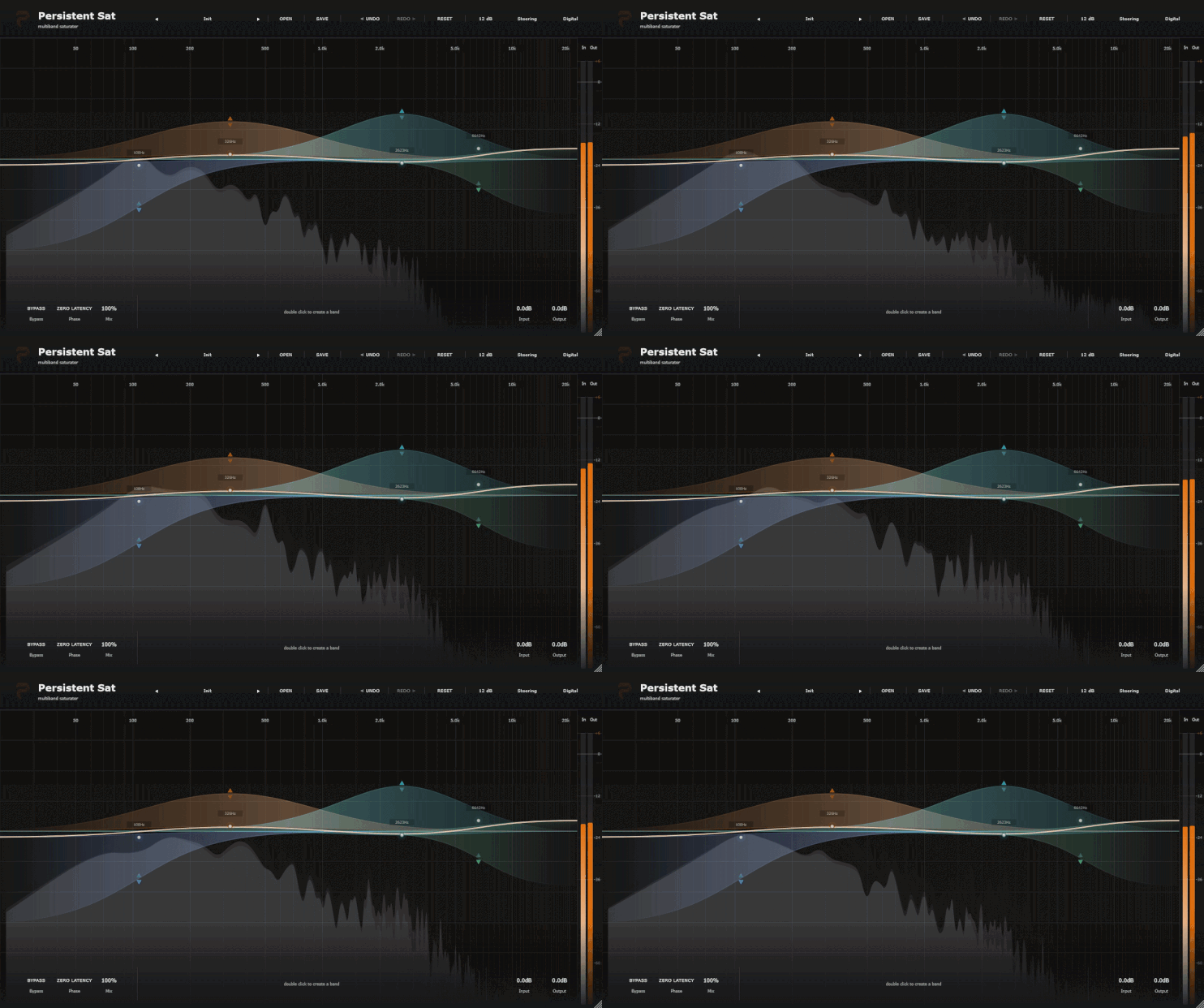
Persistent Saturator was developed to address this challenge.
Rather than treating saturation as a process applied uniformly across the entire signal, Persistent Saturator approaches harmonic generation from a frequency-selective perspective.
The system combines the precision and flexibility traditionally associated with equalization with the musical characteristics of nonlinear processing. Instead of applying saturation globally, harmonic generation can be focused on specific frequency regions through independently configurable processing bands.
This approach allows saturation to be treated as a form of spectral design.
Harmonics can be introduced exactly where they are needed. Tonal weight, presence, density, brightness, aggression, or warmth can be added to carefully selected portions of the spectrum without unnecessarily affecting the rest of the signal.
In this sense, Persistent Saturator does not simply process sound.
It shapes harmonic architecture.
Individual frequency regions can function as independent saturation zones, each possessing its own tonal objective, drive characteristics, and harmonic behavior. The result is a workflow that combines the precision of equalization with the musical expressiveness of saturation.
The practical implications extend across both mixing and mastering applications.
During mixing, saturation can be used to enhance the identity of individual instruments, reinforce important frequency regions, improve source separation, and increase perceived energy.
Within mastering workflows, subtle harmonic enhancement can strengthen tonal balance, increase perceived detail, and improve translation without dramatically altering the overall character of the material.
At the same time, the system remains capable of more aggressive creative processing when required. Harmonic coloration, spectral distortion, textural enhancement, and experimental sound design can all be approached through the same frequency-selective framework.
This flexibility reflects a broader philosophy underlying Persistent Saturator.
The objective is not merely to introduce distortion.
The objective is to provide precise control over where harmonic content is created, how it behaves, and how it contributes to the overall structure of a sound.
Understanding these principles provides the foundation for the chapters that follow. The next section explores the core concept that defines Persistent Saturator: the ability to apply distortion and harmonic generation through an equalizer-style workflow, transforming saturation from a global effect into a highly controllable spectral processing system.