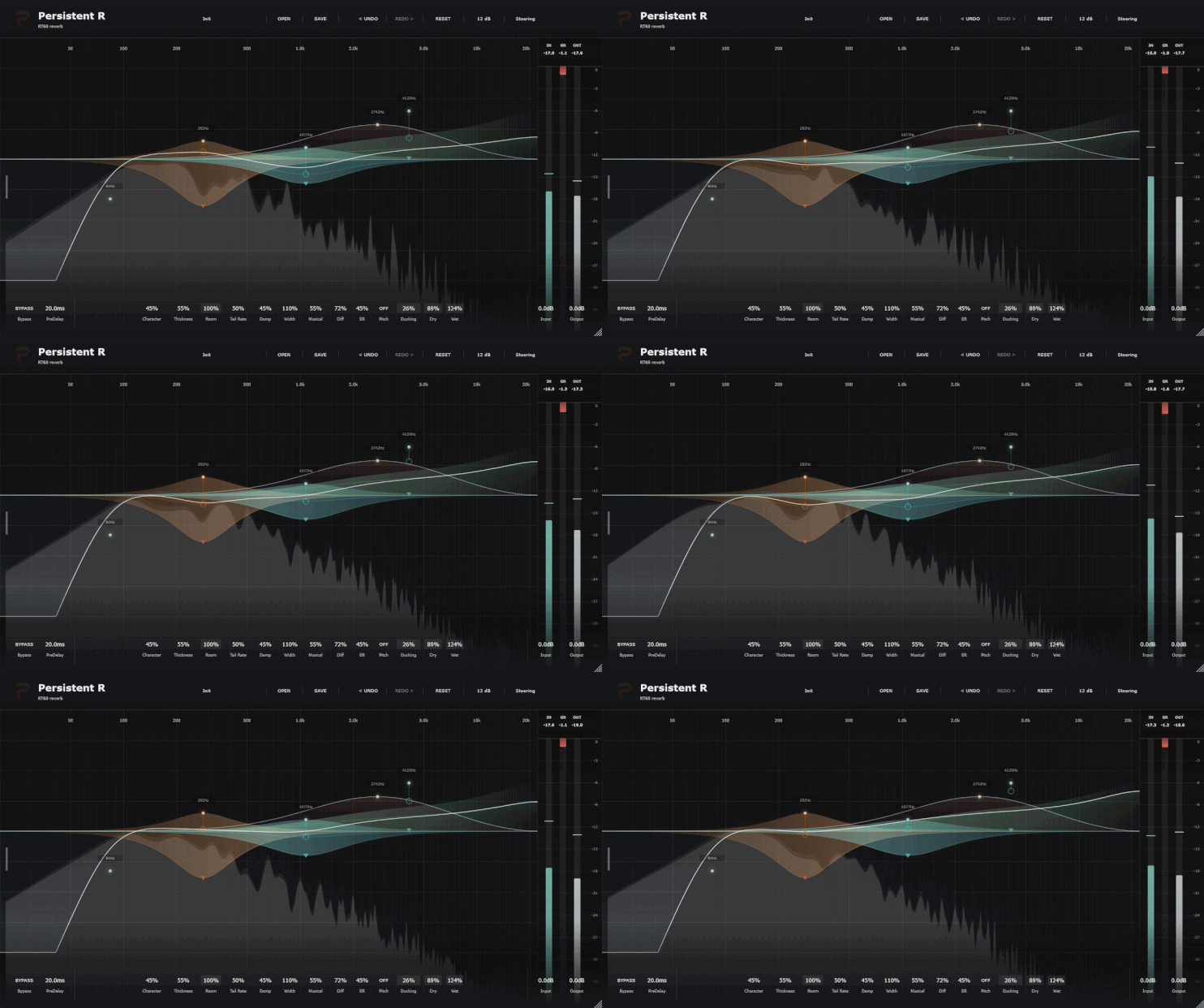
Persistent R : Ducking Control
One of the fundamental challenges of reverberation is the balance between spatial depth and source clarity.
Reverb is commonly used to create a sense of space, distance, dimension, and immersion. By introducing reflections and reverberant energy, sounds can be placed within an acoustic environment rather than appearing unnaturally dry or disconnected from the surrounding mix.
However, the very characteristics that make reverberation desirable can also create problems.
As reverberant energy accumulates, it occupies both temporal and spectral space. Reflections continue after the direct sound has occurred, overlapping with subsequent events and contributing additional energy across the frequency spectrum. While this process enhances spaciousness, it can also reduce articulation, obscure transient detail, and diminish intelligibility.
The relationship between direct sound and reverberant sound is therefore inherently competitive.
Every increase in reverberation introduces additional spatial information, but also increases the possibility of masking important elements within the source material.
This conflict becomes particularly apparent in modern music production.
Vocals require intelligibility. Drums require transient definition. Lead instruments often depend on precise articulation to remain present within a dense arrangement. Yet these same sources frequently benefit from the sense of depth and dimension that reverberation provides.
The engineer is therefore faced with a familiar compromise.
Reducing reverb improves clarity but may make the mix feel dry or two-dimensional.
Increasing reverb enhances spaciousness but may push important elements further back within the mix.
Historically, this problem has often been addressed through careful parameter selection. Shorter decay times, reduced wet levels, frequency-dependent damping, and selective equalization can all help manage excessive reverberant energy.
While effective, these approaches remain fundamentally static.
The reverb behaves the same way regardless of whether the source is actively performing or temporarily silent.
In natural acoustic environments, however, perception operates differently.
When a sound source is present, the listener's attention is primarily focused on the direct sound. The reverberant field contributes spatial context but rarely dominates perception. As the direct sound diminishes, the surrounding acoustic environment becomes more apparent and the reverberation is perceived more clearly.
This interaction forms the conceptual basis of Ducking Control.
Ducking allows the level of the reverberant signal to respond dynamically to the presence of the source material. When the source is active, the reverberation is reduced. When the source becomes less prominent or temporarily absent, the reverberation gradually returns to its intended level.
The result is not the removal of reverberation.
The result is the redistribution of attention between the source and the space surrounding it.
By controlling when reverberation becomes prominent, Ducking allows both clarity and spaciousness to coexist more effectively than would be possible through static level adjustment alone.
From a signal-processing perspective, ducking operates as a level-dependent control system.
The direct signal acts as a control source that influences the gain applied to the reverberant field. As source level increases, attenuation is applied to the wet signal. As source level decreases, attenuation is progressively removed.
The timing characteristics of this process determine how naturally the transition occurs.
Excessively fast recovery may produce audible level fluctuations within the reverberant field. Excessively slow recovery may prevent the reverb from expanding naturally during pauses and sustained decays. Effective ducking therefore depends not only on the amount of attenuation applied, but also on the temporal behavior of the control system itself.
The practical benefits of ducking vary according to the source material.
Vocals represent one of the most common applications.
A vocal often requires substantial reverberation to establish depth and emotional impact. At the same time, lyrical intelligibility depends upon maintaining a clear and dominant direct signal. Ducking allows the vocal to remain intelligible while preserving a spacious and natural reverberant environment between phrases.
Drums and percussion provide another example.
Transient definition is frequently critical to rhythmic perception. Excessive reverberation can soften attacks and reduce clarity. By reducing reverberant energy during transient events and restoring it afterward, ducking allows impact and ambience to coexist without excessive compromise.
Similar advantages can be observed with lead instruments, orchestral recordings, cinematic sound design, and modern electronic productions where large reverberant spaces must remain present without overwhelming important foreground elements.
Importantly, ducking influences perception in a manner that extends beyond simple level control.
Human listeners interpret spatial depth largely through the relationship between direct and reflected sound. When reverberation remains dominant during active passages, sources often appear more distant. When the direct signal remains clearly defined while reverberation emerges during pauses and decays, the source can maintain proximity while still existing within a large acoustic environment.
Ducking therefore affects not only clarity, but also perceived depth and spatial positioning.
Within Persistent R, Ducking Control is designed as an integrated component of spatial management rather than as a corrective afterthought.
The objective is not merely to suppress reverb whenever a source becomes loud.
Instead, the system is intended to maintain an effective balance between foreground and background information within the acoustic scene.
The source remains intelligible.
The space remains present.
Neither element is required to dominate continuously.
This philosophy reflects a broader principle of modern reverb design. Effective reverberation is not simply the creation of larger spaces or longer decays. It is the controlled integration of spatial information into the musical structure itself.
Ducking Control contributes to this objective by allowing the reverberant field to respond dynamically to the material that generates it. Rather than remaining static, the space adapts to the performance, preserving clarity when it is needed and expanding naturally when the music allows.
The result is a reverberation system capable of maintaining both articulation and immersion, enabling complex spatial environments to exist within a mix without sacrificing the definition of the sources that occupy them.