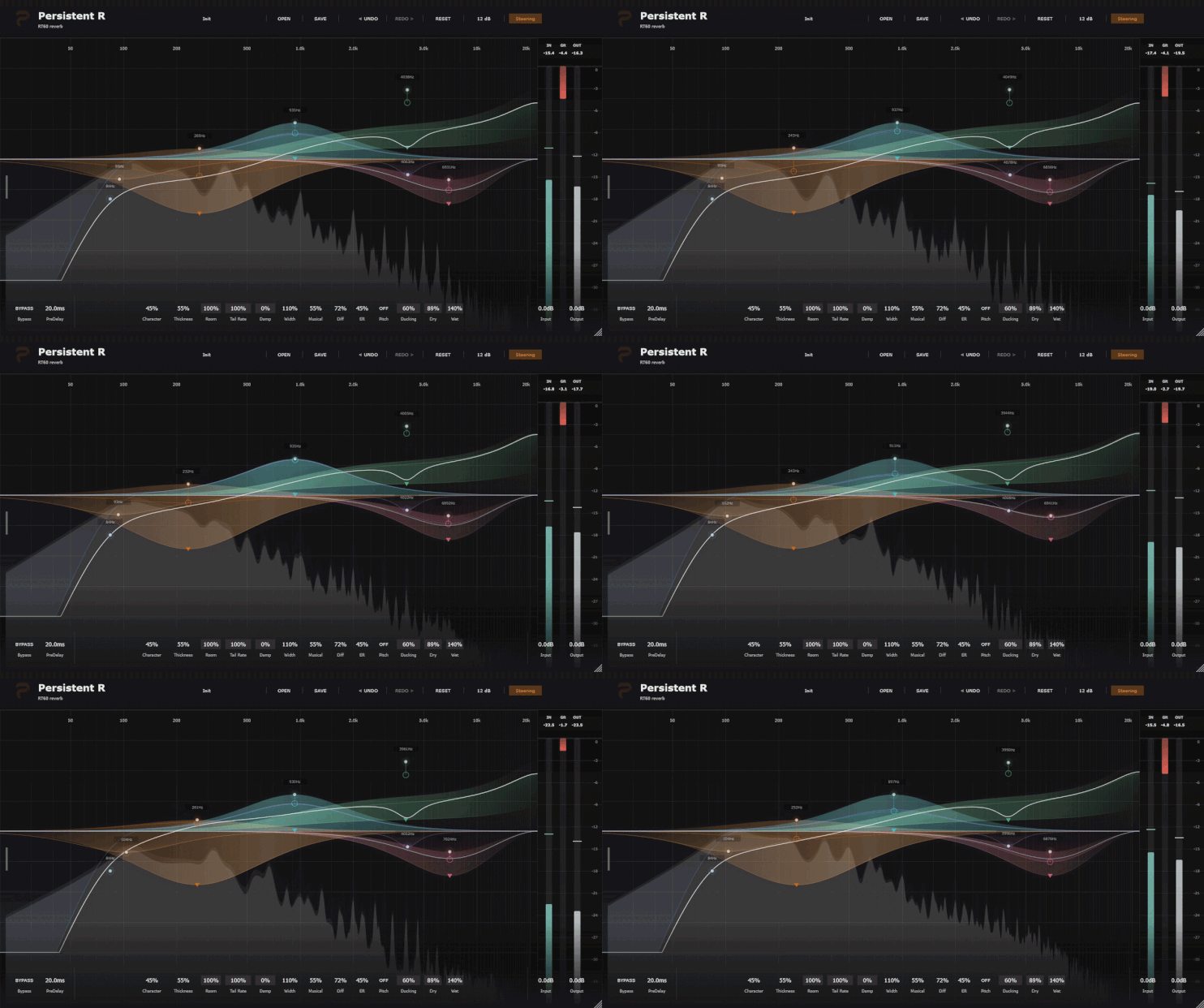
 Persistent R : Auto Steering
Natural reverberation is not spectrally uniform.
Within a physical acoustic environment, different frequency regions behave according to different physical principles. Low frequencies, mid frequencies, and high frequencies do not propagate, reflect, diffuse, or decay in identical ways. Consequently, the acoustic character of a space is never constant across the frequency spectrum.
This principle is fundamental to architectural acoustics and room design.
Low-frequency energy generally exhibits greater diffraction and lower absorption. Because of its long wavelength, bass energy often persists within a space for a longer period of time and is capable of interacting strongly with room modes and boundary surfaces.
High-frequency energy behaves differently.
Short wavelengths are more susceptible to absorption by air, furnishings, curtains, carpets, and other acoustic materials. High frequencies therefore tend to lose energy more rapidly as reflections accumulate throughout the reverberant field.
Mid-frequency content occupies a transitional region between these behaviors and is often influenced strongly by the geometry and reflective characteristics of the environment.
The result is that every acoustic space possesses a frequency-dependent identity.
A room does not have a single decay characteristic.
It has many.
Different portions of the spectrum exhibit different reflection patterns, different absorption rates, different diffusion characteristics, and different decay behaviors. The reverberant field is therefore constantly changing as the spectral balance of the source material changes.
This relationship becomes particularly important in musical applications.
A vocal performance does not maintain a fixed spectral structure. Vowels, consonants, articulation, and performance intensity continuously alter the distribution of energy throughout the frequency spectrum.
Similarly, instruments generate different harmonic structures as notes change.
A bass guitar playing a low note excites a different region of the spectrum than the same instrument playing a higher note. A piano produces a continuously evolving harmonic structure across its entire range. Orchestral and electronic sources often generate highly complex spectral movements that change from moment to moment.
Because a reverb derives its input from these signals, the acoustic behavior of the resulting reverberant field should ideally evolve as well.
Traditional reverb equalization does not account for this relationship.
A Post EQ band positioned at a fixed frequency remains stationary regardless of changes occurring within the source material. A Tail EQ band designed to influence the decay characteristics of a particular frequency region continues to operate at that location even when the dominant spectral energy has shifted elsewhere.
While effective in many situations, this approach assumes that the acoustic significance of a frequency remains constant over time.
In reality, the spectral structure responsible for generating the reverberant field is often in continuous motion.
Persistent R addresses this limitation through Auto Steering.
Auto Steering extends the adaptive frequency-domain philosophy of Persistent Q into the domain of spatial processing. Rather than treating Post EQ and Tail EQ bands as permanently fixed frequency locations, Auto Steering allows these bands to follow relevant spectral structures as they evolve within the source material.
The objective is not merely frequency tracking.
The objective is the preservation of acoustic intent.
When an engineer shapes the tonal balance of a reverb, or modifies the decay characteristics of a particular frequency region, the decision is usually based upon a meaningful acoustic feature of the source. If that feature moves, the processing should ideally remain connected to it.
Auto Steering enables this relationship to be maintained automatically.
As harmonic structures shift, the associated EQ bands can adapt their frequency position accordingly. As resonant energy migrates throughout the spectrum, processing remains focused on the intended acoustic target.
This behavior is particularly significant within Dynamic Tail EQ.
Tail EQ influences the way individual frequency regions decay within the reverberant field. Since the decay behavior of a space is inherently frequency dependent, maintaining an accurate relationship between the EQ band and the source spectrum becomes critical.
Without adaptation, a Tail EQ band may gradually lose its connection to the spectral component it was intended to influence. The resulting decay behavior may become inconsistent as notes change or harmonic structures evolve.
Auto Steering allows the decay-shaping process to remain attached to the relevant acoustic content.
As the source moves, the decay control moves with it.
The perceived spatial behavior therefore remains more consistent throughout the performance.
A similar principle applies to Dynamic Post EQ.
Post EQ determines the tonal balance of the completed reverberant field. Because different frequency regions contribute differently to perceived brightness, warmth, depth, and clarity, maintaining accurate spectral targeting is important when controlling the character of a space.
Auto Steering allows these tonal adjustments to remain associated with the evolving spectral content responsible for generating the reverberation.
The result is not simply a more adaptive equalizer.
The result is a more adaptive acoustic environment.
The reverberant field can respond to changing source material in a manner that more closely resembles the behavior of natural spaces, where frequency-dependent reflection and absorption characteristics continuously interact with the spectral content entering the room.
Persistent R provides multiple Steering Styles to determine how this adaptation occurs.
Some styles prioritize rapid responsiveness, allowing EQ bands to follow short-term spectral movement with high precision. Others emphasize stability and continuity, producing smoother transitions better suited to sustained or ambient material.
The choice of steering behavior influences how closely the acoustic environment responds to changes occurring within the source.
Importantly, Auto Steering does not attempt to create movement for its own sake.
Its purpose is to maintain consistency.
The acoustic properties of a space are inherently frequency dependent, and the spectral content entering that space is constantly evolving. Auto Steering allows Dynamic Post EQ and Dynamic Tail EQ to preserve their intended relationship to that evolving content, ensuring that tonal shaping and decay control remain focused on the musical structures they were designed to influence.
Within Persistent R, this philosophy transforms equalization from a static layer placed on top of a reverb into an active component of spatial behavior. The reverberant field becomes capable of adapting to the source material itself, allowing tonal balance, decay characteristics, and acoustic identity to evolve together as the music unfolds.