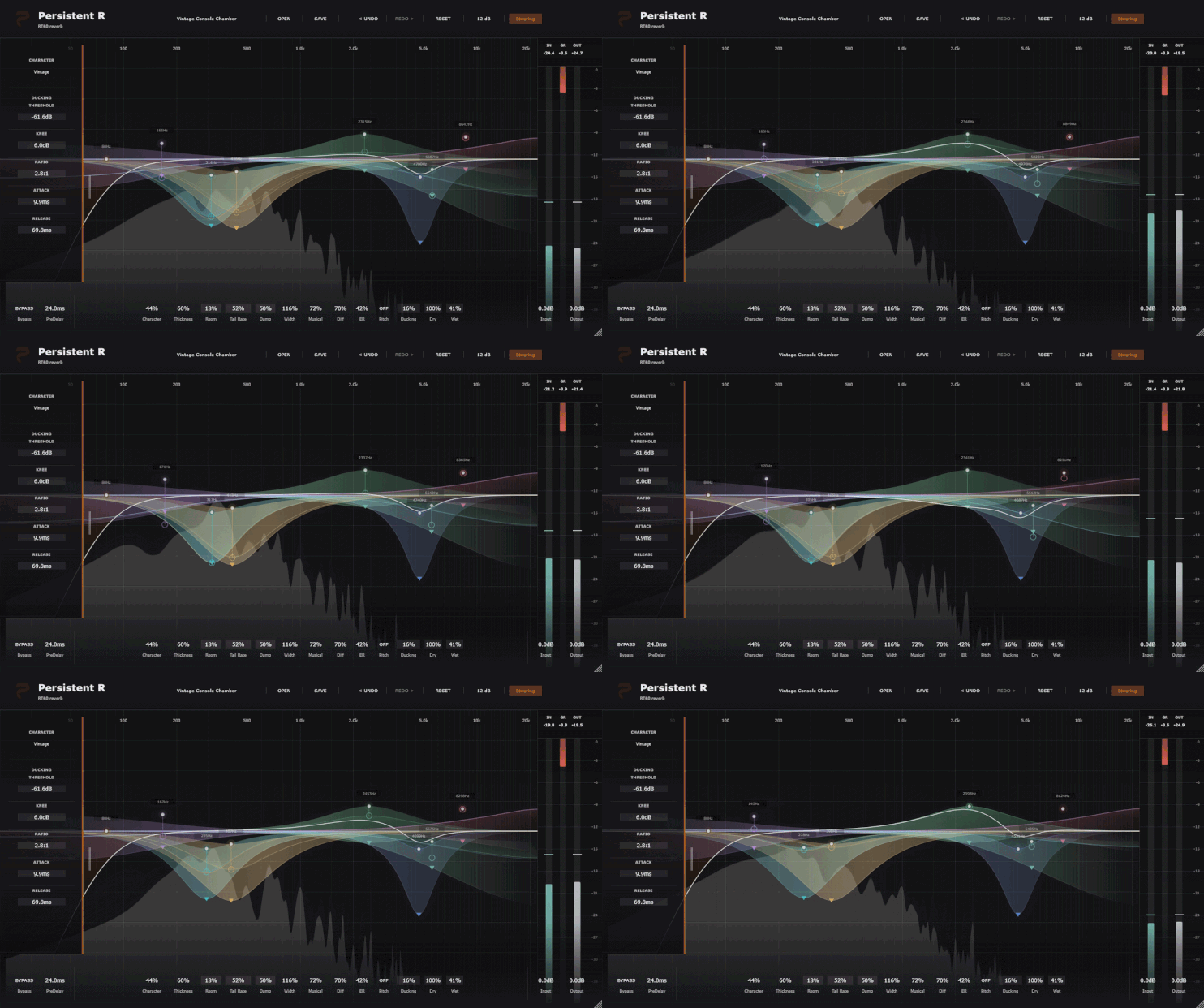
Persistent R : Dynamic Post & Tail EQ
Reverberation is often perceived primarily as a time-based effect. Parameters such as room size, decay time, diffusion, and pre-delay typically receive the greatest attention during reverb design. However, the tonal structure of a reverberant field is equally important.
Every acoustic space possesses a unique frequency response.
As sound propagates through an environment, different frequency regions behave differently. High frequencies are generally absorbed more rapidly by air, fabric, and soft materials. Low frequencies often persist longer due to their greater wavelength and reduced susceptibility to absorption. Reflective surfaces may emphasize certain spectral regions while attenuating others.
As a result, the tonal character of a room is never independent of its temporal behavior.
The decay of a reverberant field is inherently frequency dependent.
This relationship explains why large concert halls often sound warm and spacious, why small untreated rooms may exhibit pronounced resonances, and why different acoustic environments possess distinct spatial identities even when their overall decay times are similar.
Artificial reverb systems must therefore address two separate but closely related challenges.
The first challenge involves generating a convincing reverberant field.
The second involves shaping the spectral behavior of that field.
Historically, tonal control has often been performed using post-processing equalization.
Once the reverb signal has been generated, an equalizer may be inserted after the reverb stage to adjust its overall frequency balance. High-frequency attenuation can reduce harshness, low-frequency cuts can improve clarity, and broad tonal adjustments can help integrate the reverberation within a mix.
This approach remains effective and widely used.
However, conventional post-EQ operates on the final output of the reverb system. It changes the tonal balance of the reverberant signal after the reverberation process has already occurred.
The temporal structure of the decay remains unchanged.
If a frequency region naturally persists longer within the reverb engine, a post-EQ can reduce its level, but it cannot fundamentally alter how that frequency decays over time.
This distinction leads to an important concept.
The spectral balance of a reverb and the decay behavior of a reverb are not necessarily the same thing.
Two reverbs may exhibit identical frequency responses at a particular moment while possessing entirely different frequency-dependent decay characteristics.
One may produce a bright initial response that rapidly darkens over time. Another may maintain a consistent tonal balance throughout its entire decay. A third may allow low-frequency energy to persist significantly longer than high-frequency content.
The listener perceives these differences as changes in the character of the space itself.
For this reason, modern reverb design increasingly incorporates frequency-dependent decay control in addition to conventional equalization.
Persistent R addresses these requirements through two complementary systems: Dynamic Post EQ and Dynamic Tail EQ.
Although both systems operate within the frequency domain, they influence different aspects of the reverberation process.
Dynamic Post EQ focuses on the final tonal balance of the generated reverberant signal.
Conceptually, it functions as an adaptive equalization stage positioned after the reverb engine. Rather than applying static frequency adjustments continuously, Dynamic Post EQ allows processing to respond to changing signal conditions.
This approach provides a more transparent method of tonal management.
A frequency region may be attenuated only when excessive energy is present. Harsh resonances can be controlled without permanently darkening the reverb. Low-frequency buildup can be managed dynamically while preserving warmth during less demanding passages.
Because processing occurs in response to the signal itself, the tonal character of the reverb remains more flexible and responsive than would be possible with static equalization alone.
Dynamic Tail EQ serves a different purpose.
Instead of modifying the completed reverberant signal, Tail EQ directly influences the behavior of the decay itself.
This distinction is fundamental.
Traditional equalization adjusts amplitude.
Tail EQ adjusts decay characteristics.
Specific frequency regions can be encouraged to decay more rapidly or persist for longer durations relative to the rest of the reverberant field. The result is not merely a change in tonal balance, but a change in the acoustic behavior of the virtual space.
A frequency band configured for faster decay gradually loses prominence as the tail develops. A band configured for extended decay remains present for a longer portion of the reverberation process.
The listener perceives these changes as modifications to the physical properties of the environment rather than as simple equalization.
In practical applications, Tail EQ can be used to create darker and more controlled spaces by shortening high-frequency decay, while preserving openness through longer low-frequency reverberation. Conversely, extended high-frequency decay can introduce shimmer, air, and increased spaciousness.
The technique provides a level of spatial sculpting that cannot be achieved through conventional post-processing alone.
Dynamic Tail EQ extends this concept further by allowing decay behavior itself to become adaptive.
Rather than maintaining fixed decay characteristics, selected frequency regions may respond dynamically to changing spectral conditions within the reverberant field.
When excessive energy develops within a particular region, the associated decay can be shortened automatically. When the energy subsides, the decay characteristics may gradually return toward their original state.
This behavior allows the reverb to manage its own spectral density over time.
Resonant buildup can be reduced without removing desirable ambience. Problematic frequencies can be controlled while preserving the natural movement of the decay. The reverberant field remains responsive rather than static.
The interaction between Dynamic Post EQ and Dynamic Tail EQ creates a more sophisticated approach to reverb design than either process could achieve independently.
Dynamic Post EQ manages what the listener hears.
Dynamic Tail EQ manages how the space behaves.
One operates on the output of the reverberation process. The other operates within the temporal structure of the reverberation itself.
Together, they provide simultaneous control over spectral balance and frequency-dependent decay behavior.
This distinction reflects a broader evolution in modern spatial processing.
Traditional reverbs often treated tonal shaping and temporal behavior as separate concerns. Contemporary workflows increasingly require these elements to interact. As mixes become denser and production techniques more demanding, reverbs must adapt to changing musical conditions without overwhelming the source material.
Persistent R was designed around this principle.
Rather than treating equalization as an external corrective process, Dynamic Post EQ and Dynamic Tail EQ integrate spectral control directly into the architecture of the reverb system. Frequency balance, decay behavior, and dynamic response become interconnected components of a unified spatial design workflow.
The result is a reverb environment that can be shaped not only in terms of size and duration, but also in terms of how individual frequencies evolve, interact, and disappear over time. This allows spatial design to move beyond static room simulation toward a more responsive and musically adaptive model of reverberation.