Persistent Q: Introduction
Equalization sits at the very heart of audio engineering. Alongside dynamic processing, level control, and spatial effects, it's one of those foundational tools that shows up in virtually every mixing and mastering session. At its core, EQ is about shaping the spectral balance of an audio signal, selectively boosting or cutting specific frequency regions to change how something sounds.
Every sound has its own unique distribution of energy across the audible spectrum, and the relationship between the lows, mids, and highs contributes enormously to how we perceive a sound's character. Shift that balance and you shift the entire feel of the source: clarity, warmth, brightness, weight, presence, depth, all of it is fair game. That's why EQ isn't just a corrective tool. It's a genuinely creative one, capable of fundamentally changing how a listener experiences a source within a mix.
In day-to-day use, EQ tends to serve a handful of overlapping goals. You might be going after an unpleasant resonance, carving out space between sources that are stepping on each other, improving the intelligibility of a vocal, compensating for a recording that didn't quite capture what you were after, or just dialing in the overall tonal balance of a track. The specific objective shifts depending on the material, but the underlying idea stays the same: deliberate, predictable control over spectral content.
That control becomes especially important once you start layering multiple sources together. In a real mix, instruments and vocals rarely get their own isolated corner of the spectrum. A lead vocal shares midrange energy with guitars, keys, or synths. A bass competes with the low end of the kick drum. As more sources pile up, the cumulative spectral density of the mix increases, and clarity starts to suffer.
This is what's usually referred to as frequency masking, where one sound makes another less audible simply because they're occupying overlapping spectral territory. EQ gives you a way to manage those interactions, redistributing energy so individual sources can each occupy a more distinct slice of the spectrum. Done well, it improves separation and intelligibility without the mix feeling artificially carved up.
The way an EQ actually achieves this is through filters, each of which modifies the amplitude of specific parts of the spectrum while leaving other areas relatively untouched. Different filter types handle different jobs.
High-pass and low-pass filters are probably the most commonly reached-for options. A high-pass filter rolls off everything below a set cutoff frequency, letting the higher content through unaffected, while a low-pass filter does the reverse, trimming the top end and passing the lows. These tend to be the first moves in a lot of sessions, whether you're cleaning up low-frequency rumble, taming excessive high-end energy, or just establishing sensible bandwidth limits on a source.
Shelf filters take a broader approach to tonal adjustment. A high shelf raises or lowers everything above the target frequency, while a low shelf does the same below it. Because they affect such a wide range at once, shelves are better suited to general tonal shaping than surgical work.
Peaking filters, more commonly called bell filters, form the backbone of the modern parametric EQ. A bell filter boosts or cuts energy centered around a specific frequency, with the effect gradually tapering off as you move away from that center point. The width of that adjustment is controlled by the Q parameter, which defines the relationship between the center frequency and how much of the surrounding spectrum gets pulled in. A tight Q keeps things focused, making it ideal for targeting resonances and specific problem frequencies, while a wide Q casts a broader net and tends to feel more natural for general tonal shaping. The interplay between frequency, gain, and Q is really the foundation of most parametric EQ work.
Beyond these, there are a few more specialized filter types worth knowing. A notch filter is essentially a bell taken to an extreme, designed to remove an incredibly narrow slice of the spectrum while leaving everything around it intact. It's particularly useful for suppressing hum, ringing, or stubborn isolated resonances. A band-pass filter works in the opposite direction, letting only a specified frequency range pass while attenuating everything above and below it, and it shows up regularly in sound design, restoration, and more experimental processing contexts.
For most of audio history, all of this has been done with static filters. Once you set a frequency response, it stays there regardless of what the incoming signal is doing. That approach works extremely well in a lot of situations, but modern production tends to present more complicated challenges than static filters alone can handle. A resonance might only rear its head on specific notes. Vocal character can shift significantly over the course of a performance. Spectral imbalances often come and go depending on signal level and musical context, making a fixed filter a blunt instrument when you need something more surgical.
Dynamic equalization developed as a direct response to those limitations. Rather than holding a fixed frequency response, a dynamic EQ lets filter behavior respond to what's actually happening in the incoming signal, applying processing only when it's needed. The result is more transparent control over resonances, harshness, low-frequency buildup, and other level-dependent spectral issues. In a sense, dynamic equalization bridges the gap between traditional frequency-domain processing and the reactive nature of dynamic range control.
Modern EQ workflows have continued to evolve well beyond straightforward gain adjustments. Spectral processing techniques now make it possible to analyze and control individual frequency components within a broader region independently, rather than treating an entire band as a single block. This kind of processing can respond to localized resonant structures within a signal, offering a level of precision and transparency that simply wasn't available with traditional approaches.
What started as a method for correcting tonal imbalances has grown into a comprehensive system for managing spectral relationships, keeping resonances in check, enhancing clarity, and shaping the overall presentation of audio material.
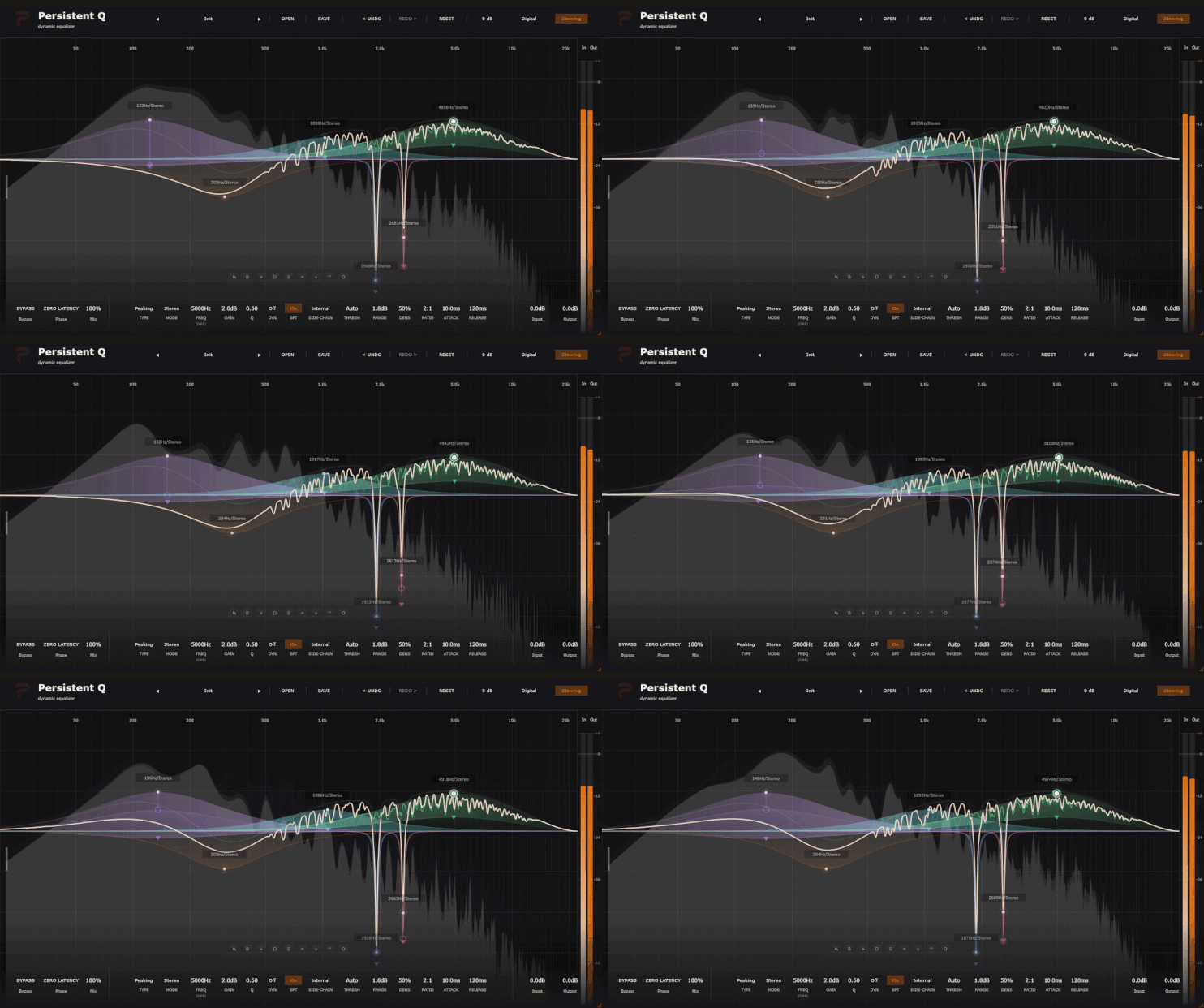
Persistent Q was built with all of this in mind. It brings together the familiar workflow of a traditional parametric EQ with modern dynamic and spectral processing capabilities, making it possible to handle both corrective and creative equalization tasks within a single environment. Getting comfortable with the concepts covered here gives you a solid foundation for everything else discussed throughout this series.